
Piezo Micro-Gripper Provides Force Control to 0.005N for Optics and Photonics Automation
Source: PR Newswire
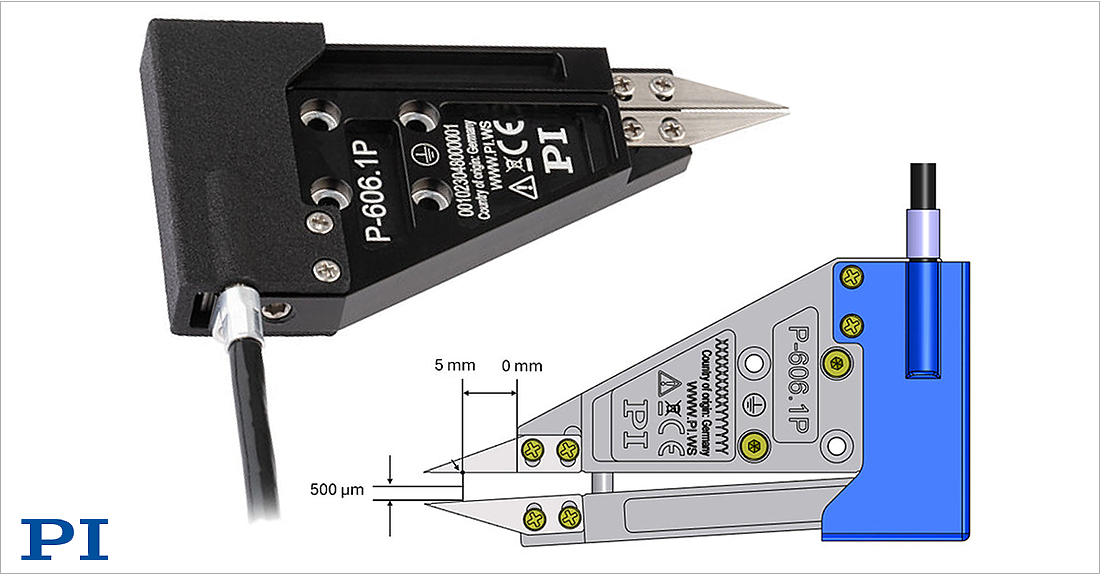
Physik Instrumente launched the P-606.1P piezoelectric microgripper for automated photonics manufacturing, offering 0–500 µm jaw travel, 0.005 N force resolution, and up to 4 N clamping force. The device combines friction-free flexure mechanics, piezo actuation, and integrated force sensing to improve handling of delicate optical components in alignment, assembly, probing, and inspection workflows. The announcement is a product-specification update with limited immediate market-moving implications.
Analysis
This is not yet a revenue-relevant event for public automation or photonics names; it is a component-launch claim without pricing, customer qualification, throughput data, or design-win disclosure. The near-term implication is limited to a modest validation of the broader factory-automation bottleneck shifting from positioning accuracy to yield-preserving handling, particularly in fiber-array and co-packaged-optics assembly.
The more investable second-order effect is on automated-test and alignment economics. If force-feedback end-effectors reduce breakage, rework, or alignment-cycle time, the value accrues disproportionately to production-scale equipment integrators rather than to the gripper supplier: MKS Instruments (MKSI), Coherent (COHR), and IPG Photonics (IPGP) have greater exposure to photonics manufacturing capex, while Teradyne (TER) and Cognex (CGNX) are broader automation proxies. This remains a 6-18 month adoption question, dependent on data-center optical-interconnect demand translating into manufacturing-capex orders.
Consensus is likely to overread any precision-component innovation as immediately bullish for the optical supply chain. In practice, higher automation can lower labor and scrap costs but may also intensify equipment-price competition and enable capacity additions faster than demand, pressuring gross margins for component assemblers. A credible bullish signal would be disclosed yield or cycle-time improvements in qualified high-volume FAU or silicon-photonics production, not laboratory specifications.
No standalone trade is warranted on this release. Monitor MKSI, COHR, and IPGP quarterly commentary for backlog conversion, photonics-specific order growth, and customer capex commitments; a broad reduction in hyperscaler AI capex or continued weak industrial automation orders would falsify the automation-upgrade thesis before it becomes investable.
AllMind Terminal
AI-powered research, real-time alerts, and portfolio analytics for institutional investors.
Request TrialMarket Sentiment
Overall Sentiment
mildly positive
Sentiment Score
0.20
Key Decisions for Investors
- No new position based solely on this release; treat it as a watch item rather than a catalyst.
- Add MKSI, COHR, and IPGP to an optical-manufacturing automation watchlist for the next 1-3 earnings cycles; upgrade only if management quantifies photonics order growth, manufacturing yield gains, or incremental backlog tied to automated alignment.
- For existing TER or CGNX exposure, do not extrapolate this into near-term revenue acceleration: require improving book-to-bill and industrial-automation guidance before adding risk.
- Potential 6-18 month pair, contingent on confirmed photonics-capex acceleration: long MKSI versus short CGNX, expressing higher sensitivity to precision photonics production rather than broad discrete-factory automation. Exit if MKSI reports declining semiconductor/photonics orders or if hyperscaler capex guidance is cut.
More News
- China's AI leaders keep quiet despite U.S. 'publicity' on tech risks
- Exclusive-Malaysia talks to rival airlines as it monitors AirAsia’s financial health, sources say
- MBS and Saudi Arabia Face Crisis With Key Oil Pipeline Shut for Weeks
- AWS says it can't restore service to Bahrain, UAE facilities 6 months after Iran strikes
- Chinese investors rush into US stocks as Beijing opens wider path overseas
- Factbox-How AI leaders and world governments react to ’AI doom’ fears