
Industry Partnerships Offer New Opportunities for Universities Amid Federal Funding Pressures
Source: PR Newswire
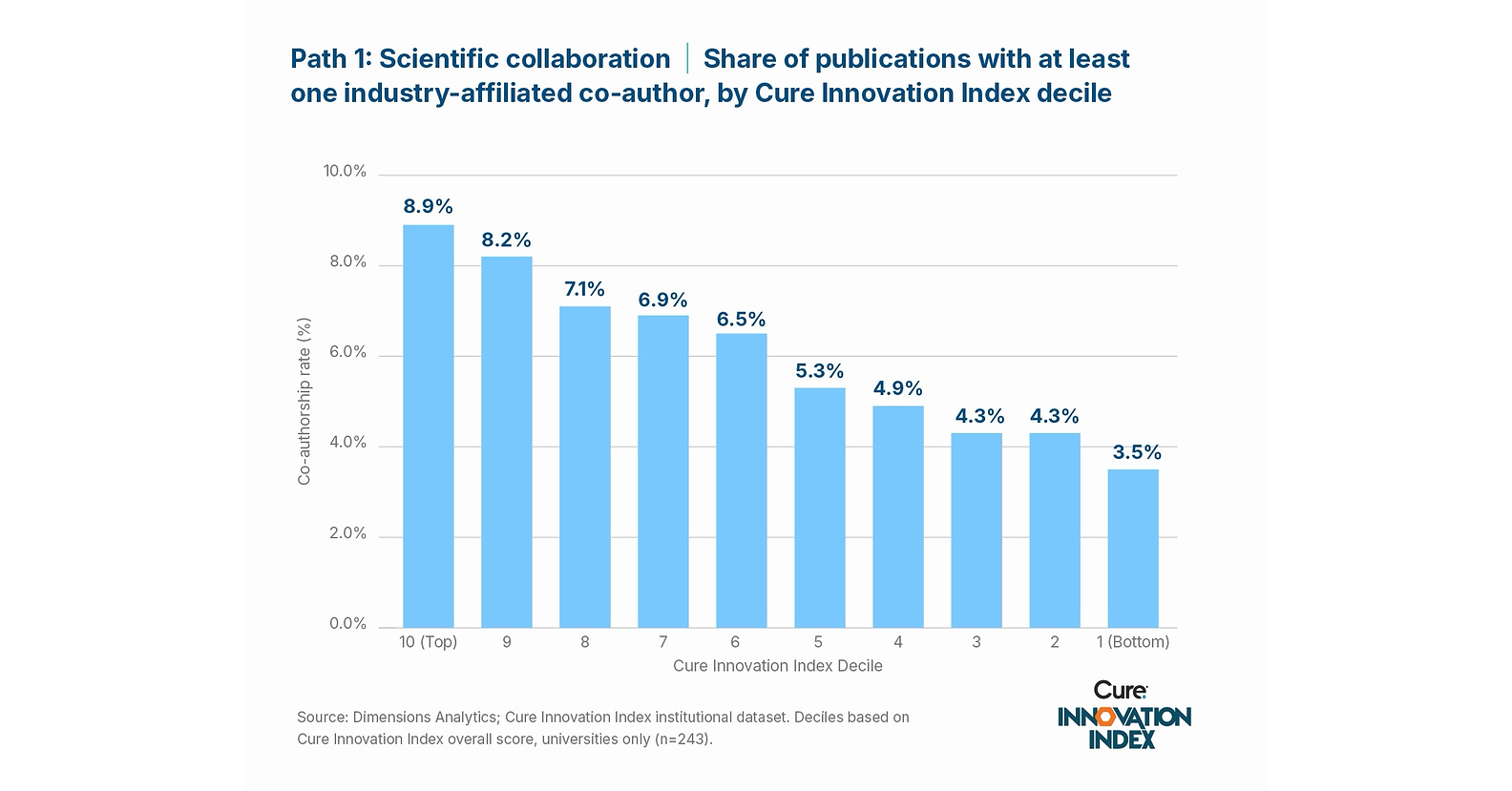
Cure Innovation Index analysis found that lower-ranked universities can outperform elite institutions in commercialization-focused industry engagement: bottom-decile schools receive STTR awards at 0.82 per $10M of research funding versus 0.18 for top-decile schools, while I-Corps awards run 0.83 versus 0.15 per $10M. The findings come as the FY2027 budget request proposes a 12% ($5B) cut to NIH funding, more than a halving of NSF funding, and a 15% cap on NIH indirect-cost reimbursements. Top-ranked universities continue to lead in industry co-authorship (8.9% versus 3.5%) and industry-sponsored trial activity (24.5% versus 19.0%), but the data suggest pharmaceutical and biotech companies should assess specialized partnership capabilities rather than institutional prestige alone.
Analysis
This is not directly investable university news, but it reinforces a medium-term shift in the sourcing of early biomedical innovation: capital-efficient regional academic medical centers and commercialization ecosystems may become more relevant counterparties as non-dilutive research funding tightens. The likely beneficiaries are CROs with decentralized site networks—IQVIA (IQV), ICON (ICLR), Fortrea (FTRE)—and clinical-data vendors rather than large-cap pharma alone, because sponsors can diversify enrollment away from elite academic centers where overhead, contracting complexity, and investigator competition are highest.
For biotechs, the key second-order effect is a potentially cheaper and faster path to investigator-sponsored studies, STTR-linked technology validation, and trial enrollment through specialized regional centers. That favors platform companies with broad external collaboration needs over single-asset developers, but the financial effect will be gradual: university funding stress takes 6-18 months to affect licensing terms, sponsored-research budgets, and site-selection behavior. Do not treat partnership announcements as proof of value creation; monitor enrollment velocity, trial start-up timelines, and R&D expense per patient as the measurable transmission channels.
Contrarian view: reduced federal support could impair the upstream discovery engine rather than create a clean commercialization windfall. Smaller institutions may be efficient at partnership formation but lack the translational infrastructure, IP-prosecution resources, and follow-on capital needed to convert activity into FDA-approvable assets. If indirect-cost restrictions are implemented, academic medical centers could raise sponsor budgets or deprioritize lower-margin investigator work, offsetting any apparent site-cost advantage.
Near-term equity impact is low absent appropriations clarity. A sustained federal funding reduction would be a 2027-28 negative for tools suppliers with meaningful academic exposure, including Thermo Fisher (TMO), Danaher (DHR), and Bruker (BRKR), while CROs may see offsetting demand only if sponsor trial budgets remain intact.
AllMind Terminal
AI-powered research, real-time alerts, and portfolio analytics for institutional investors.
Request TrialMarket Sentiment
Overall Sentiment
mixed
Sentiment Score
0.12
Key Decisions for Investors
- No directional trade on the release itself; set a policy alert around final FY2027 appropriations and NIH indirect-cost implementation. The relevant catalyst window is post-midterm appropriations, not the next earnings cycle.
- Watch-list pair for a confirmed academic-funding contraction: long IQV / short TMO, sized modestly over 6-12 months. Thesis requires IQV booking growth and site-network utilization to improve while TMO cites incremental academic/biopharma instrument demand pressure; exit if NIH funding is restored or TMO academic-sales commentary remains resilient.
- For biotech diligence, favor companies reporting multi-site regional academic trial networks only when they disclose enrollment rates, activation timelines, and per-patient costs. Treat university collaboration headlines without these metrics as non-actionable.
- Monitor BRKR and TMO for 2027 guidance sensitivity to university/government end markets; a material cut in federal research support could pressure order growth before revenue, creating a short opportunity only after management confirms weakening backlog or academic demand.
More News
- US 30-Year Yield Hits Highest Since 2004
- Trump, Xi Address AI, Taiwan During State Visit
- Oracle Japan shares surge 7% after record fiscal first quarter, bucking selloff of U.S. parent
- China's Xi urges U.S. to cooperate on AI
- Trump Hosts China’s Xi With Trade, AI, Taiwan in Focus
- Analysis: Higher Treasury yields deliver a reality check on a hot, inflation-prone economy
From AllMind Research
- Anthropic IPO Preview: Valuation, Timing, and What to Watch
- Shein After the IPO: Venue, Valuation, and What Must Be Proved
- What AI Research Tools Should a Small Hedge Fund Buy First?
- Weekly Update: Unstructured Data Search, Ask AI, and Advanced Futures Data
- Best AI Stock Research Tools for Professional Investors