
Pearson research warns of a 'triple capability gap' emerging as AI adoption outpaces education and training in skilled occupations
Source: PR Newswire
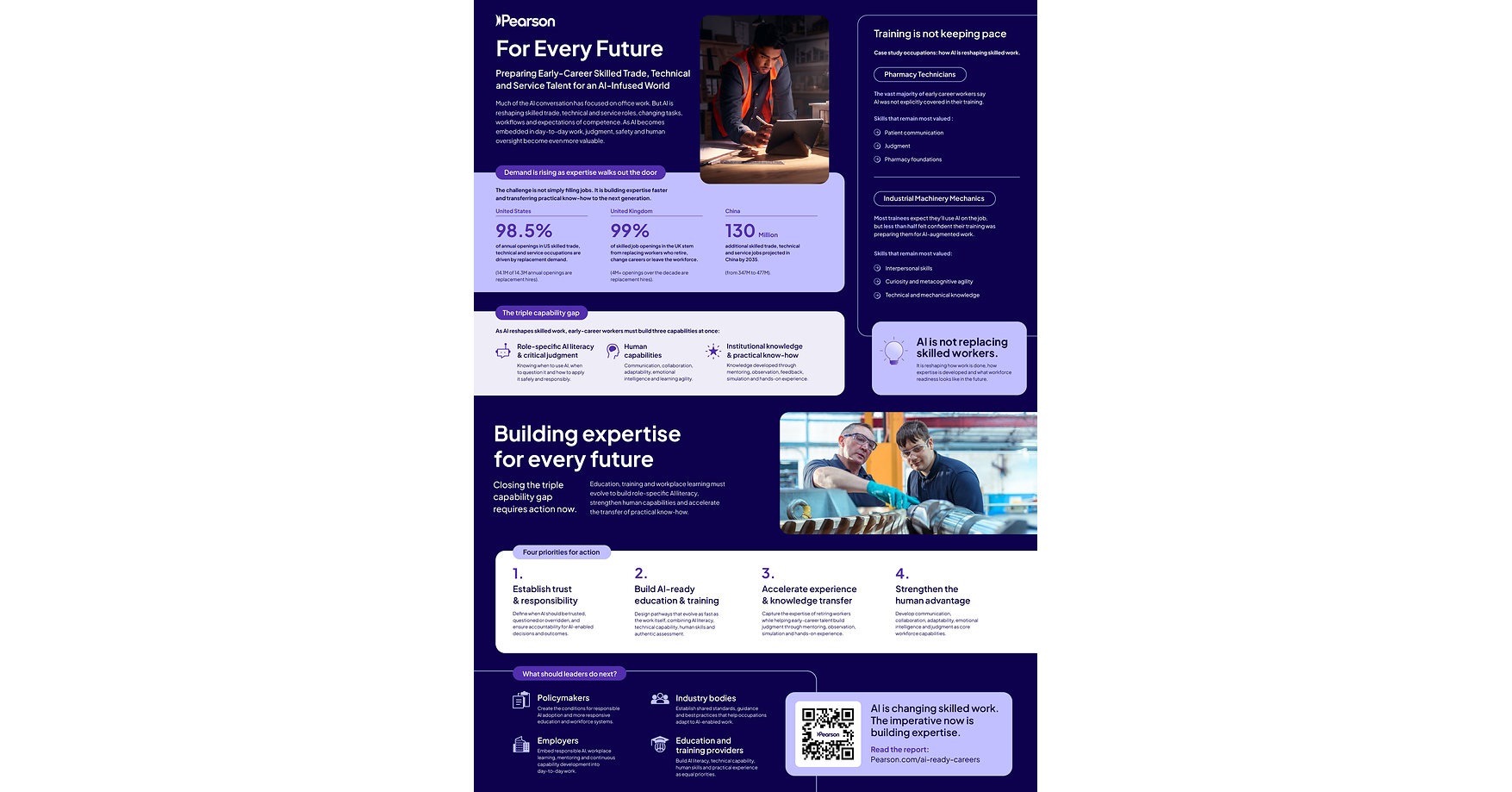
Pearson's new research warns that AI adoption is creating a "triple capability gap" in skilled trade, technical and service roles: role-specific AI judgment, durable human skills and practical institutional knowledge lost through retirements. Replacement demand accounts for 99% of skilled-job openings in the UK and 98.5% in the US, while fewer than half of industrial machinery mechanics believe their training prepares them for AI-enabled work. Pearson cautions that without faster evolution in education, mentoring and hands-on workplace learning, safety-critical services, infrastructure operations and economic growth could be affected.
Analysis
This is strategically supportive for Pearson (PSO) but not yet an earnings catalyst: the investable question is whether role-specific credentialing, assessment and employer-funded training convert into higher-value recurring digital revenue rather than low-margin content spend. Pearson's installed base in assessment and vocational qualifications gives it a distribution advantage, but enterprise procurement cycles for regulated, safety-critical training are typically 6-18 months and require evidence of compliance outcomes. The near-term release is therefore more likely to reinforce the multiple than change FY estimates.
The more actionable second-order effect is labor scarcity raising the ROI on workflow software that captures expert knowledge before retirement. Industrial automation and maintenance vendors such as Siemens (SIEGY), Rockwell (ROK), Hexagon (HXGBY), and PTC (PTC) can bundle AI-enabled guidance, simulation, digital twins and remote-expert tools into installed-base contracts; this shifts spending from discretionary training budgets toward uptime and safety budgets. Cognizant (CTSH) has potential services exposure, but generic AI consulting is less defensible than verticalized implementations tied to validated operating procedures.
Consensus may overestimate immediate labor substitution from AI in physical and regulated work. In these settings, AI initially increases the value of certified human oversight, which can preserve wage pressure and delay labor-cost savings for hospitals, manufacturers and utilities over the next 1-3 years. The thesis fails if enterprise customers demonstrate that copilots reduce supervised-training time or error rates materially without additional credentialing spend; watch Pearson's digital/enterprise bookings, PTC and ROK recurring software growth, and disclosed safety or productivity ROI case studies through the next two reporting cycles.
AllMind Terminal
AI-powered research, real-time alerts, and portfolio analytics for institutional investors.
Request TrialMarket Sentiment
Overall Sentiment
mildly negative
Sentiment Score
-0.30
Ticker Sentiment
Key Decisions for Investors
- No standalone PSO trade on this release; place PSO on a 6-12 month watchlist for evidence that vocational/enterprise AI offerings lift digital revenue growth or bookings. Upgrade only after two quarters of measurable acceleration; absent that, the narrative does not justify multiple expansion.
- Favor a 6-18 month long PTC or ROK versus short CTSH basket exposure: operational AI embedded in maintenance and factory workflows has clearer budget ownership and switching costs than horizontal implementation services. Target 15-20% upside versus 10% downside; exit if recurring software growth decelerates by more than 300bps or bookings fail to convert.
- Monitor healthcare-training and pharmacy-workflow vendors for compliance-driven spend rather than betting on provider labor-margin relief. A verified reduction in error rates or onboarding duration is the catalyst; without outcome data, treat training-demand claims as a qualitative theme rather than a position trigger.
- For industrial and utility operators, do not underwrite AI-related SG&A or labor savings in the next 12 months without evidence of reduced apprenticeship, supervision, or incident costs. Near-term wage and training investment may instead compress margins, creating downside risk for consensus estimates in labor-intensive service businesses.
More News
- Saudi, Turkish, Pakistani chiefs plan urgent talks amid Yemen fighting
- Japan approval, a 27% surge: the diagnostics stock our models picked in September
- Trump Versus Xi: How Their High-Stakes Summits Compare
- Trump, Xi Address AI, Taiwan During State Visit
- SEBI Allows Portfolio Managers to Invest Overseas, Short Equity Options
- China's Xi urges U.S. to cooperate on AI