
Geotab launches Investigations and new safety capabilities to help fleets make every journey safer
Source: PR Newswire
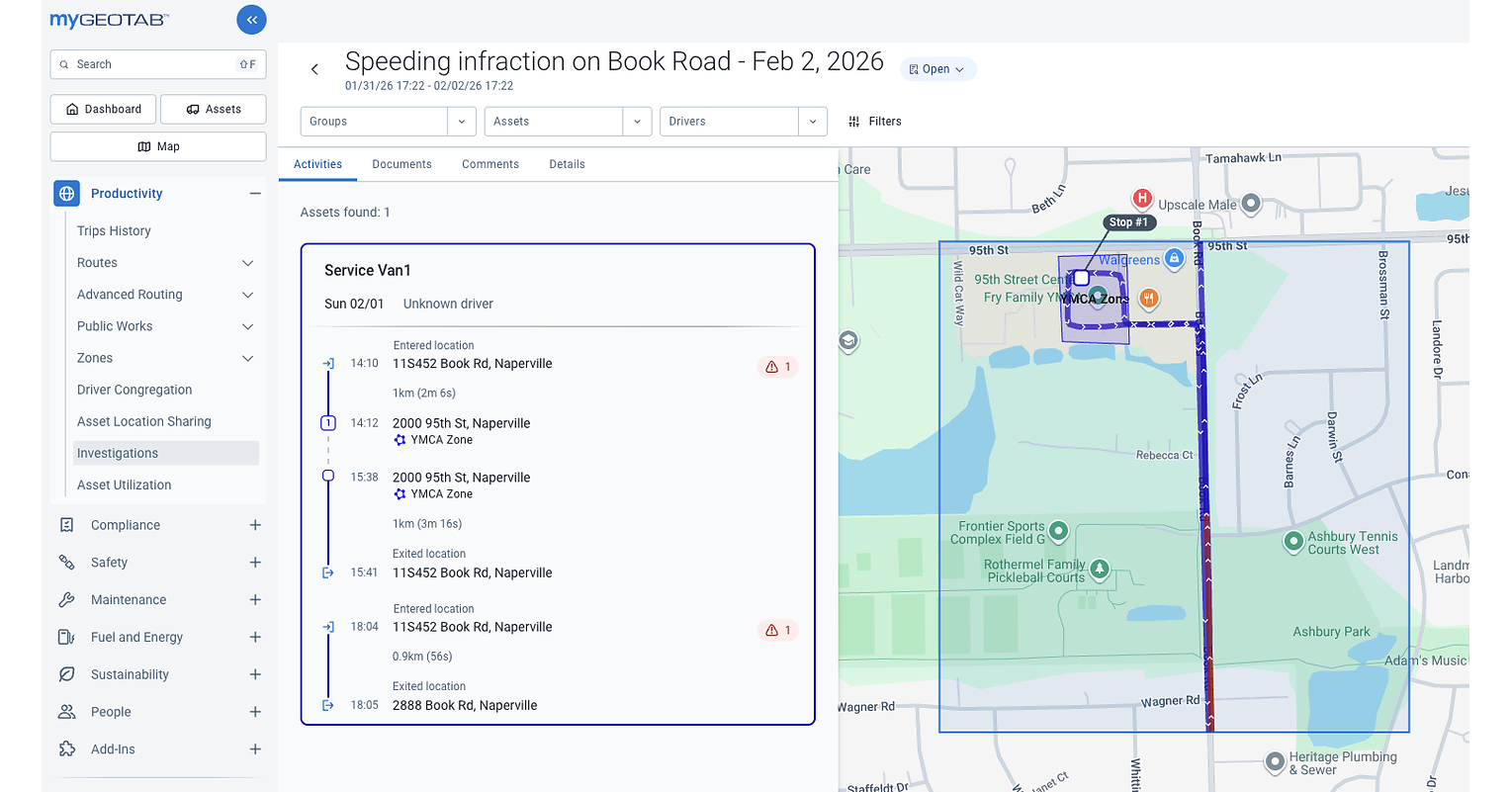
Geotab launched Investigations, a unified telematics-based incident-resolution workflow, alongside expanded AI-video coaching, a new 0–100 Safety Metric dashboard and red-light violation detection. The company cites customer results including a 22% reduction in collision risk, a 59% improvement in safe-driving behaviors and a 411% ROI within two months for Richfords; Barhale reduced preventable collisions by 8.8% and insurance premiums by 2.7% despite 40% fleet growth. The product expansion strengthens Geotab's connected-fleet safety offering but is unlikely to have broad public-market impact.
Analysis
Geotab is private, but the launch raises the competitive bar for listed fleet-software vendors rather than creating an immediately investable event. Samsara (IOT) is the most exposed public peer: incident workflow, video integration and driver-risk prioritization are high-retention modules that support ARPU expansion and reduce customer churn. The important mechanism is bundling—if Geotab can make third-party cameras usable within its core workflow without incremental software cost, standalone video/telematics providers face greater pricing pressure and fleets have less reason to add point solutions.
The legal disclaimer is material: the product is explicitly not an evidence-preservation or chain-of-custody service. That limits near-term displacement of specialized claims, legal-hold and enterprise video-evidence systems, while also constraining the extent to which fleet customers can underwrite litigation-cost savings into procurement ROI. Over 1-3 months, monitor whether IOT reports increased competitive win rates or attach rates for video, safety, and insurance-related modules; absent such evidence, this is routine product-parity news rather than a catalyst. Over 6-18 months, the larger structural winner is the vendor that converts safety scores into insurer-recognized premium reductions, because verified underwriting savings create a budget-funded sales motion rather than a discretionary software purchase.
Contrarian view: investor enthusiasm around AI safety features may overstate near-term monetization. Fleet customers generally require hardware deployment, driver acceptance, policy changes and insurer validation before behavior improvements translate to P&L savings; those implementation frictions delay revenue realization. Conversely, Geotab's support for heterogeneous camera hardware could accelerate platform consolidation and make pure-play hardware vendors more vulnerable than software investors currently assume.
AllMind Terminal
AI-powered research, real-time alerts, and portfolio analytics for institutional investors.
Request TrialMarket Sentiment
Overall Sentiment
mildly positive
Sentiment Score
0.32
Key Decisions for Investors
- No directional trade solely on this announcement; Geotab is private and the disclosed financial impact is not independently measurable. Set an alert around Samsara (IOT) quarterly disclosures for video-subscriber growth, net retention and safety-module attach rate—an unexpected deceleration would indicate Geotab bundling is becoming commercially consequential.
- Maintain a 3-6 month relative-value watch: long IOT / short Trimble (TRMB) only if IOT demonstrates sustained fleet-software ARPU growth while TRMB's Transportation segment shows margin or organic-growth pressure. Target a 10-15% relative return; exit if IOT net retention weakens or TRMB raises transportation guidance.
- Monitor PowerFleet (PWFL) for competitive vulnerability rather than initiate immediately. A decline in SaaS revenue growth, gross-margin guidance, or large-fleet renewal commentary would support a short thesis, since smaller vendors have less capacity to subsidize cross-hardware integrations; lack of those signals falsifies the thesis.
More News
- Two camps have emerged in the debate over AI safety and regulation
- U.S. stock futures drift higher with Fed rate hike in focus
- Exclusive-Malaysia talks to rival airlines as it monitors AirAsia’s financial health, sources say
- MBS and Saudi Arabia Face Crisis With Key Oil Pipeline Shut for Weeks
- AWS says it can't restore service to Bahrain, UAE facilities 6 months after Iran strikes
- Oil’s next test: Saudi Arabia races to restore a key safety valve for prices