
AllMind vs Claude for Financial Services
AllMind is an AI research system for institutional investors: 6,800+ premium data sources and the firm’s own systems in one ontology, with agents across both.
Claude for Financial Services packages Anthropic’s general-purpose models for finance: Enterprise seats, plugins, Microsoft 365 add-ins and MCP connectors.
The split is who supplies the content, who enforces entitlements, and who keeps the log.
The licensed corpus arrives with the seat, mapped to the firm’s own warehouse as one ontology. Agents run across both for minutes or hours and return a cited Word memo, Excel model or deck, under per-user entitlements they inherit and cannot widen.
Claude Enterprise or Team seats plus finance plugins, Agent Skills, Microsoft 365 add-ins and MCP connectors into FactSet, S&P Global, LSEG, Moody’s, Third Bridge and others, which generally read on the firm’s own data entitlements.
If your desk already licenses its data and has engineers to wire and govern the workflow, Claude plus connectors is a defensible architecture. If the content, the entitlements and the log have to arrive with the product, that is the AllMind case.
Feature by feature
What ships with the seat
Premium market and fundamental data included
- AllMind
- Supported
- Claude for Financial Services
- Bring your own license
Filings corpus (EDGAR and SEDAR) included
- AllMind
- Supported
- Claude for Financial Services
- Via connector
Sell-side broker research included
- AllMind
- On a delay
- Claude for Financial Services
- Via connector
Expert-call transcripts included
- AllMind
- Supported
- Claude for Financial Services
- Connector, own contract
Ontology linking entities and relationships
- AllMind
- Supported
- Claude for Financial Services
- Not supported
Reasoning and models
Its own frontier model
- AllMind
- Not supported
- Claude for Financial Services
- Supported
Independent finance-benchmark standing
- AllMind
- Not benchmarked
- Claude for Financial Services
- Tops Vals v1.1, second on v2
Coding agent for the engineering team
- AllMind
- Not supported
- Claude for Financial Services
- Supported
Deliverables and workflow
Excel, Word and PowerPoint add-ins
- AllMind
- Generates the files
- Claude for Financial Services
- Supported
Decks, memos and models from templates
- AllMind
- 20+ IB templates
- Claude for Financial Services
- Skills and plugins
Citations back to the source passage
- AllMind
- Supported
- Claude for Financial Services
- Cell and doc level
Verification pass before a report ships
- AllMind
- Supported
- Claude for Financial Services
- Not documented
Governance and audit
Per-user entitlements agents inherit
- AllMind
- Supported
- Claude for Financial Services
- Not documented
Every access logged in-platform
- AllMind
- Supported
- Claude for Financial Services
- Enterprise audit logs
Office add-in activity in the audit log
- AllMind
- No M365 add-in
- Claude for Financial Services
- Not supported
SOC 2 Type II
- AllMind
- Supported
- Claude for Financial Services
- Supported
ISO 27001 certified
- AllMind
- Targeted Q1 2027
- Claude for Financial Services
- Supported
ISO/IEC 42001 certified
- AllMind
- Not documented
- Claude for Financial Services
- Supported
Automation and engineering
Scheduled recurring agent runs
- AllMind
- Agent Studio
- Claude for Financial Services
- Public beta
Public API to host your own agents
- AllMind
- Not documented
- Claude for Financial Services
- Supported
Automation across a coverage list
- AllMind
- AllMind states up to 200
- Claude for Financial Services
- No stated cap
Commercial
Published list pricing
- AllMind
- Not supported
- Claude for Financial Services
- Supported
Self-serve signup, no sales call
- AllMind
- Not supported
- Claude for Financial Services
- Supported
Data licensing inside the price
- AllMind
- Supported
- Claude for Financial Services
- Not supported
Compiled on 30 August 2026 from Anthropic’s newsroom posts of 15 July 2025, 27 October 2025 and 5 May 2026, the February 2026 Cowork finance-plugin post, claude.com product documentation and pricing, and AllMind product documentation. Where the two products tie, the row says so, and every row Claude wins is marked as such. A cell reading “Not documented” records silence in the vendor’s own published material, which is not the same finding as a capability that is missing.
See AllMind on your own coverage→What a research system does that a reasoning layer cannot
Claude reasons over data you already license. AllMind ships the license.
Claude reasons over data you already license, and Anthropic says so. Its install tutorial says connector access “may require a separate subscription or API key from the respective provider”. LSEG is blunter, listing “Active LSEG data entitlements, your existing subscription to the relevant LSEG content” as a prerequisite for its plugin. So for FactSet, S&P Global, LSEG, Moody’s, Third Bridge and Guidepoint, the content Claude reads is generally content the firm already pays for on separate paper. Anthropic writes “may require” rather than “requires”, so treat that as the normal case for premium sources, not a universal rule.
AllMind sells the other half of that sentence. The seat comes with 6,800+ premium data sources and 750M+ documents: S&P, FactSet, LSEG and MSCI data, broker research, Expert Insights transcripts, live news and newswires from thousands of sources worldwide, global investor-relations data, live earnings and financials within minutes, alternative data and sector-specific collections. Live embargoed broker research still runs on the firm’s own RMS entitlement, and aftermarket research arrives on a delay that varies by broker.
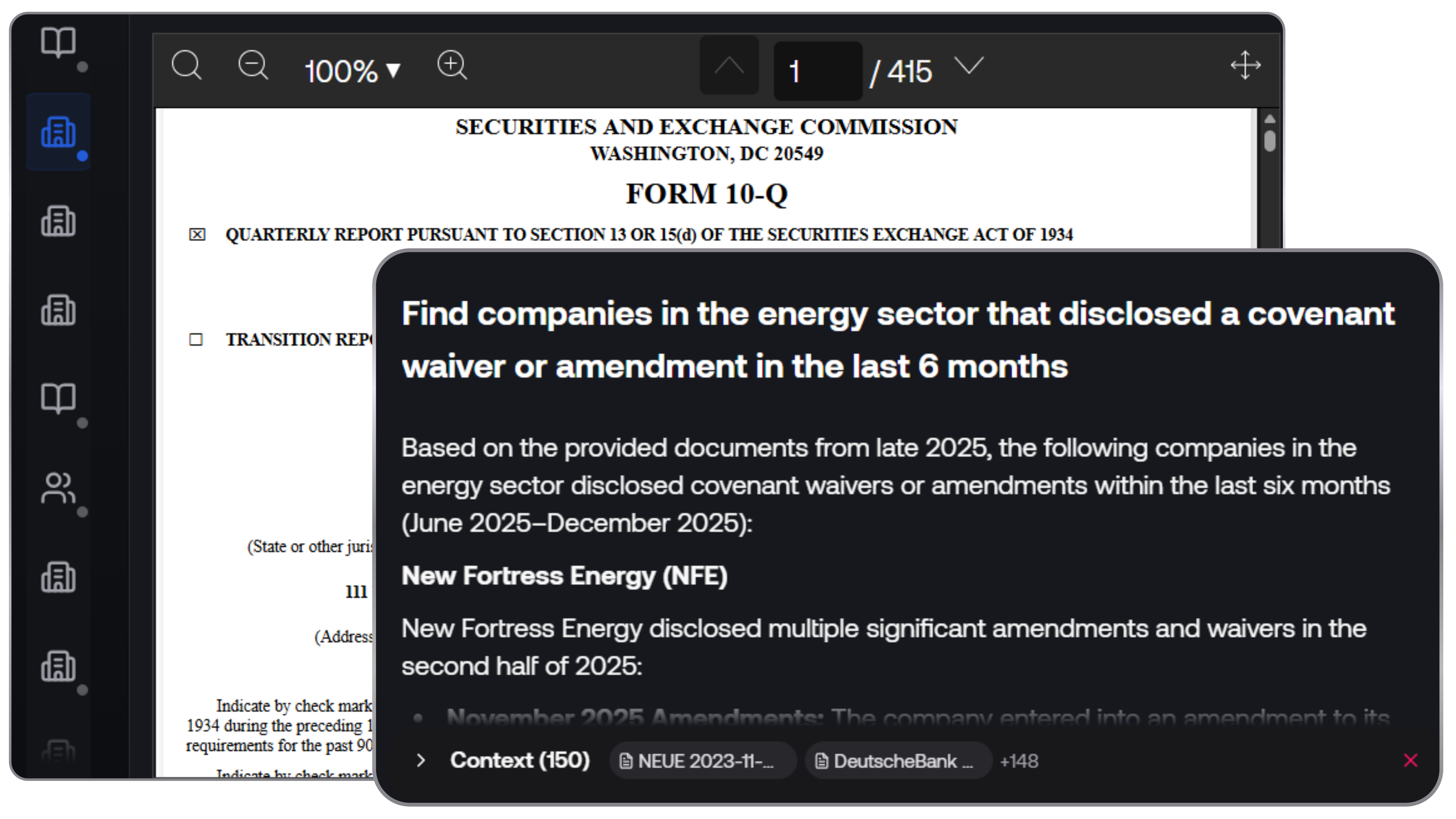
An audit trail is a product decision, not a property of the model.
Claude’s most finance-shaped surface sits outside Anthropic’s own audit log. The page for Claude for Excel says the add-in “does not inherit custom data retention settings your organization might have set” and that “Activity is not included in Enterprise audit logs or the Compliance API”. Claude Enterprise does carry role-based access with fine-grained permissioning, SCIM, audit logs and a compliance API at the account layer, so this is one surface rather than a general failing. It is the surface where the modeling happens.
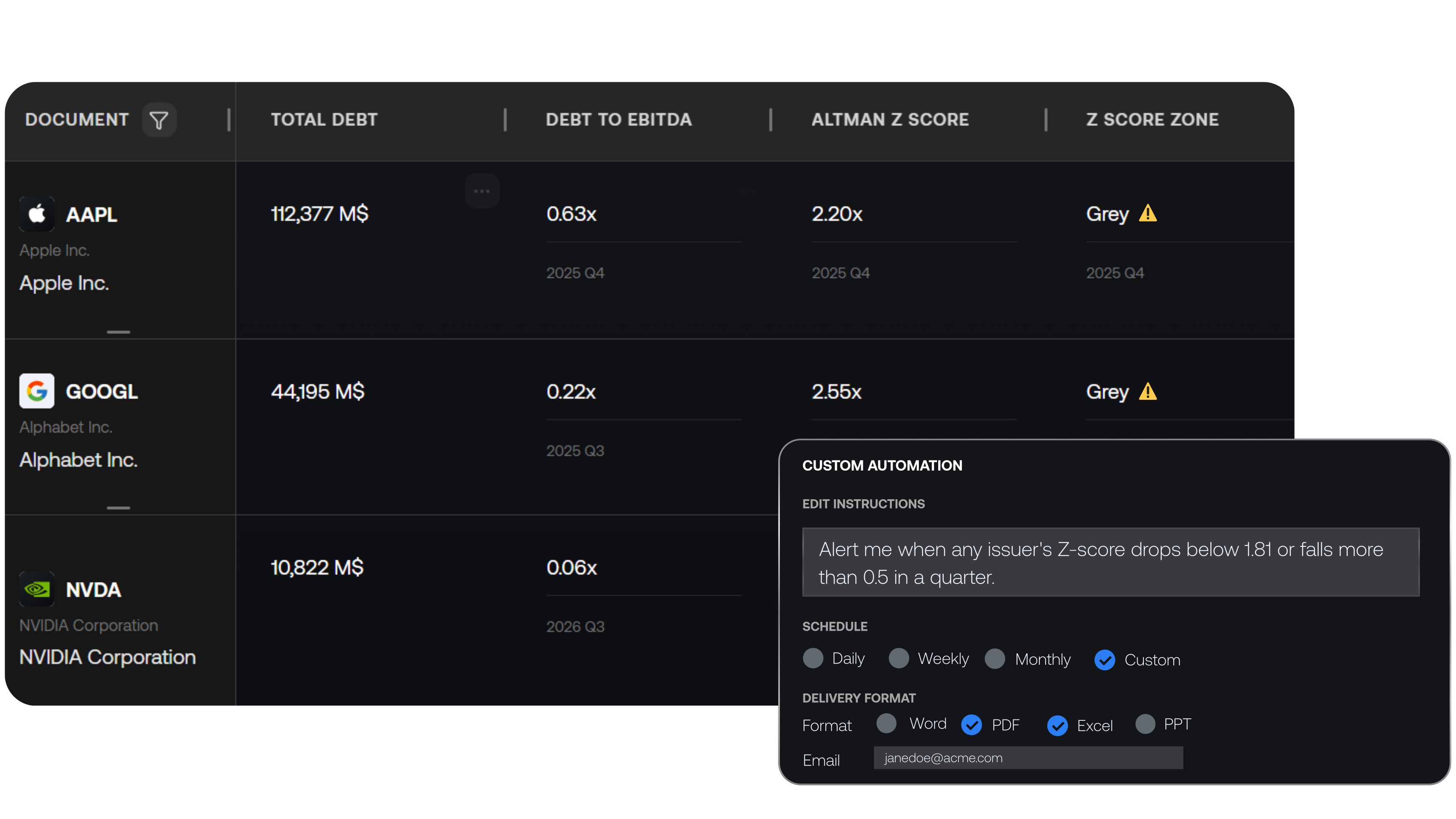
AllMind puts the control inside the research object instead. Permissions and Audit is one of six architectural layers: per-user entitlements are inherited by agents and can never be widened by them, and every access in or out is logged. Every figure traces back to the passage in its source document with the calculation visible, and a verification pass re-checks the numbers before anything ships. Anthropic holds the broader certificate set today.
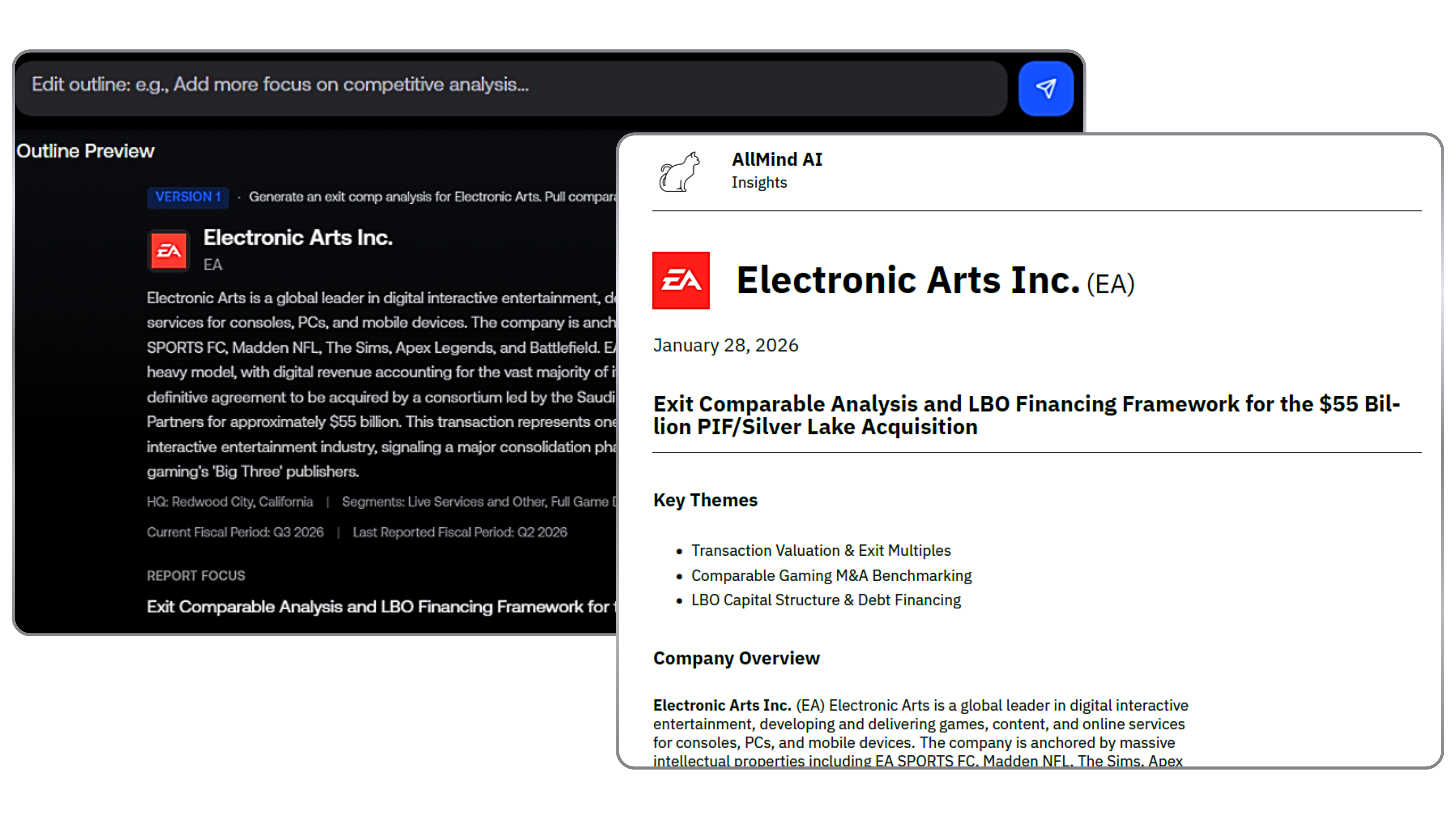
Second-order questions break a connector fan-out.
Ask what a supplier’s guidance cut means for the three names you cover and the job is traversal, not retrieval. Claude assembles context per call, querying each attached MCP connector and reasoning over whatever fits in the window. That works, and Claude reasons better than almost anything else you can point at the problem. It also means the link between a supplier, a customer and an estimate revision gets rebuilt on every question, and the answer is bounded by whatever was connected that day.
AllMind maintains a financial ontology instead: companies, suppliers, customers, estimates, filings and the firm’s own research as entities and relationships, so an agent walks the graph rather than fetching documents one at a time. The 6,800+ premium data sources are already present; only the internal, firm-specific layer goes as deep as the systems a customer connects. That is why onboarding opens with a data conversation rather than a signup.
Where Claude for Financial Services is strong
On the public evidence Claude is the strongest general reasoner in this comparison set. Claude Opus 4.7 tops the independent Vals AI Finance Agent v1.1 leaderboard at 64.37% accuracy across 537 questions, with Sonnet 4.6 second at 63.33% (vals.ai, updated 4 June 2026). A later, harder v2 set put Claude Opus 5 second at 58.63% behind Muse Spark 1.2, though it was not visible when we last checked, so v1.1 stays the confirmed read.
The cadence is documented and fast: connectors in July 2025, Claude for Excel and six Agent Skills in October 2025, Cowork finance plugins in February 2026, ten agent templates and eight more connectors in May 2026. Going-concern risk is small too: Anthropic raised in May 2026 at a $965B post-money valuation, with run-rate revenue it says crossed $47 billion. Other finance AI vendors build on it, Rogo and Hebbia among them. For a firm that already licenses its data and has engineers, Claude plus connectors is a real architecture, not a shortcut.
One reasons over whatever you attach. The other ships the content, the rules and the log.
AllMind
The AI research system for institutional investors
An institutional research platform where the licensed corpus, the firm’s systems and the relationships between them sit together. AllMind states 750M+ documents across 6,800+ premium data sources and 40+ exchange and venue feeds: S&P, FactSet, LSEG and MSCI data, broker research, Expert Insights, live news and newswires from thousands of sources worldwide, global investor-relations data, live earnings and financials within minutes, alternative data and sector-specific collections.
Warehouses are reached through scoped IAM roles and queried where they sit, not copied into an index. Agents run over the whole map for minutes or hours, returning cited memos, models and decks.
Claude for Financial Services
The frontier reasoner with finance connectors
Anthropic’s finance packaging of its general-purpose models, launched 15 July 2025 and sold on Claude Enterprise and Team seats. On top sit finance plugins for Cowork and Claude Code, Microsoft 365 add-ins led by Claude for Excel, a library of finance Agent Skills, and ten agent templates shipped in May 2026.
Every premium source arrives through an MCP connector rather than from Anthropic, which holds no data license, filings corpus or expert library of its own (read across Anthropic’s newsroom and product pages, 30 August 2026).
What each one is good at, and what it costs you
AllMind
- 6,800+ premium data sources and 750M+ documents included with the seat
- Expert Insights transcripts and broker research as built-in classes, not connectors
- A financial ontology of companies, suppliers, customers, estimates and filings to traverse
- Snowflake, Databricks and S3 queried in place through scoped IAM roles
- Agents inherit a user’s entitlements, can never widen them, and every access is logged
- A single agent run can span minutes, hours or days across many data points
- No self-serve tier and no monthly plan, unlike the Claude plans a card can buy
- SOC 2 Type II is certified today, while ISO 27001 is targeted for Q1 2027
- A bespoke house format still needs a formatting pass, since deliverables land in supplied templates
- 18 markets live today, so an Asia-Pacific or LATAM mandate is not served yet
Claude for Financial Services
- Claude Opus 4.7 tops the independent Vals AI Finance Agent v1.1 leaderboard at 64.37%
- Published list prices and self-serve signup from $20 per seat a month billed annually
- Claude for Excel is generally available, with cell-level citations in the open workbook
- Managed Agents give cron scheduling, credential vaults, per-run budgets and self-hosted sandboxes
- SOC 2 Type I and Type II, ISO 27001:2022 and ISO/IEC 42001:2023 (company-stated)
- One contract that also covers Claude Code and general knowledge work across the firm
- Ships no market data, filings corpus, broker research or expert transcripts of its own
- Claude for Excel activity is not included in Enterprise audit logs or the Compliance API
- Premium connectors generally need the firm’s own subscription with the data provider
- No finance-tier price is published, and scheduled agent deployments are still in public beta
What AllMind and Claude for Financial Services actually cost
AllMind
Quote only, with the data licensing inside it
Every deployment starts with a data conversation rather than a checkout, and there is no monthly plan, so a retail or otherwise non-institutional buyer is genuinely better served elsewhere. The figure on the contract already carries the premium content, which is the line item a Claude seat leaves to the firm.
- Platform subscription
- No published price, quote-based
- Self-serve or monthly plan
- None offered
- Premium data licensing
- Inside the subscription
Claude for Financial Services
Published plan prices, no finance SKU
claude.com/pricing lists the general Claude plans and the finance vertical rides on them. The Enterprise card is headed “Seat price + usage at API rates” and reads “$20/seat. Usage cost scales with model and task”, which is the self-serve headline; further down, a comparison section splits it into self-serve and sales-assisted paths and prints no price against either. Treat any specific Claude for Financial Services price as unsourced.
- Pro
- $17 a month with the annual discount ($200 up front), $20 monthly
- Team, standard seat
- $20 per seat a month billed annually, $25 monthly
- Team, premium seat
- $100 per seat a month billed annually, $125 monthly
- Enterprise, self-serve
- $20 per seat, plus usage at API rates
- Claude for Financial Services tier
- No separate price published anywhere
- Median Anthropic contract
- $138,462 a year, from 101 purchases
- Anthropic contract range
- $48,000 to $500,000 a year, same 101-purchase sample
- SMB average spend
- $55,993 a year, 50 to 1,000 employees
- Enterprise average spend
- $441,517 a year, from 160 customers
What changes the quote
On the Claude side the seat price is the small number. Token usage comes first: the Enterprise line says “Usage cost scales with model and task”, and Managed Agents lets you cap what a scheduled run may spend. Then the data: every premium source is licensed from someone else, so a firm reading LSEG, FactSet, S&P Global or Third Bridge content pays those vendors separately at institutional rates. Then build cost: turning an agent template into something compliance will sign off on is an engineering and policy project.
On AllMind the movers are seats, which internal systems get connected, and whether the firm holds its own RMS entitlement.
The two numbers are not like-for-like, and the difference is the data. Anthropic’s seat price excludes the content while an AllMind quote includes the licensing, so a $20 seat and a quote-based platform are answering different questions. The Vendr and SpendHound figures measure total Anthropic spend, mixing API consumption with seats, neither isolates the finance vertical, and both are directory samples rather than prices anyone was quoted, so they belong in a budget range and nowhere near a contract.
Which one you want, task by task
Two analysts on a credit desk have to read this quarter’s filings and broker commentary across 40 names, without signing four data contracts first.
The 6,800+ premium data sources, broker research and Expert Insights arrive with the seat, so nothing has to be licensed and wired before the assistant is useful. Claude reads whatever the desk already pays for, and Anthropic’s own install tutorial says connector access may require a separate subscription or API key from the provider.
A quant platform team wants a nightly agent that reads the firm’s own Snowflake tables, calls an internal risk API, and posts a digest into Slack.
Claude’s Managed Agents API decides this: documented cron scheduling with minute granularity, credential vaults, per-run spend budgets and self-hosted sandboxes, in public beta since 9 June 2026. A team with engineers builds and hosts exactly the agent it wants, which no vendor automation builder matches.
An analyst has to say what a supplier’s guidance cut means for three names under coverage, defensibly enough to put in an IC memo.
The answer depends on mapped supplier and customer relationships rather than on what a connector happened to return, so the ontology does the work, and passage-level traceability plus the verification pass make the read-across reviewable afterwards.
A global bank that already licenses LSEG, FactSet and Moody’s wants one AI contract covering research, engineering, KYC and month-end close.
Scope decides it. Claude amortizes across seats a research platform will never touch, and Anthropic’s own pages describe finance agents for month-end close, KYC screening and AML investigation. AllMind stays the entitlement and audit layer under the research desk, where agents inherit per-user permissions and every access is logged.
Pick by which half of the problem is binding: a licensed corpus, entitlements and an audit trail that arrive with the product, or the strongest general reasoner you can point at data you already license.
Choose AllMind when the research is deep and multi-source and the answer must survive review: the corpus comes with the seat, the ontology walks from a supplier’s guidance to the names you cover, and figures trace to the passage before a verification pass.
Choose Claude for Financial Services when the constraint is reasoning rather than content, when the firm already pays for its data, or when the buyer is the whole firm. Expect the entitlement and audit layer to be work you do rather than work you buy.
AllMind vs Claude for Financial Services, answered
Only if the fund already licenses its own market data, filings and research, because Claude ships none of that itself. Anthropic’s install tutorial says connector access “may require a separate subscription or API key from the respective provider”.
A fund with those contracts and engineering capacity can build a strong workflow on Claude, whose reasoning tops the independent Vals AI Finance Agent v1.1 leaderboard at 64.37% (vals.ai, updated 4 June 2026). A fund without them is buying a reasoning layer without a corpus.
AllMind includes 6,800+ premium data sources, Expert Insights and broker research with the seat, though live embargoed research still needs the firm’s own RMS entitlement.
See AllMind on your own coverage
Join leading hedge funds and institutional investors who trust AllMind.Join leading hedge funds and institutional investors who trust AllMind to accelerate their research and analysis.