
AllMind vs Fiscal.ai
AllMind is a research system for institutional investors: entitled broker research, Expert Insights, live earnings and the firm’s own Snowflake tables, joined by an ontology under per-user entitlements. Fiscal.ai, FinChat until June 2025, is a fundamentals terminal and data API over its own filing-linked numbers.
One is bought through procurement, the other with a card.

Bought when one question crosses several content classes and the firm’s own data. Agents run for minutes, hours or across days, and the work lands as a cited memo, an Excel model with live formulas, or a deck.
Bought when the job is clean public-company numbers, fast. Its docs state about 55,000 listed companies, roughly 12,000 API-enabled, segment KPIs on the largest 2,300 by market cap, and a click from any figure to its filing page.
Public fundamentals only, and Fiscal.ai reaches them today for a monthly fee or an API key. Broker entitlements, expert calls and warehouse tables together, under one permission model, and that is AllMind.
Feature by feature
Commercial model and access
Free tier
- AllMind
- Not supported
- Fiscal.ai
- Supported
Self-serve plan prices on the vendor’s own site
- AllMind
- Not supported
- Fiscal.ai
- Self-serve tiers
Enterprise agreement and procurement
- AllMind
- Supported
- Fiscal.ai
- API and data only
Data corpus and entitled content
Filings, fundamentals and transcripts
- AllMind
- Supported
- Fiscal.ai
- Supported
Sell-side broker research in-platform
- AllMind
- AMR included; live via RMS
- Fiscal.ai
- No sell-side; Morningstar bundled
Expert-call transcripts
- AllMind
- Expert Insights
- Fiscal.ai
- Not supported
Alternative and supply-chain data
- AllMind
- Supported
- Fiscal.ai
- Not supported
Fund-letter corpus
- AllMind
- Fund-manager documents included
- Fiscal.ai
- Supported
Fundamentals depth and coverage
Filing-sourced segment and unit KPIs
- AllMind
- Operating KPI & segment datasets; Fiscal deeper
- Fiscal.ai
- Largest 2,300 companies
Analyst estimates, price targets and ratings
- AllMind
- LSEG I/B/E/S estimates and revisions
- Fiscal.ai
- In the terminal, tier-gated; not in the API
Insider and institutional ownership data
- AllMind
- Ownership and holdings
- Fiscal.ai
- US-listed only
Market-data reach
- AllMind
- 40+ feeds; live US intraday
- Fiscal.ai
- Intraday on a 15-minute delay
Filings coverage outside the US
- AllMind
- Global filings; EDGAR & SEDAR+ named
- Fiscal.ai
- US and CA full, UK and EU partial
AI workflow and deliverables
Cited chat over the corpus
- AllMind
- Supported
- Fiscal.ai
- Supported
Excel models with live formulas
- AllMind
- Supported
- Fiscal.ai
- In-app templates
PowerPoint decks generated from templates
- AllMind
- Supported
- Fiscal.ai
- Not documented
Word memos and research notes
- AllMind
- Supported
- Fiscal.ai
- Not documented
Scheduled or event-triggered agents
- AllMind
- Supported
- Fiscal.ai
- Webhooks only
Internal data, governance and audit
Warehouse connected and queried in place
- AllMind
- Supported
- Fiscal.ai
- Not supported
Your own documents in a data room
- AllMind
- Supported
- Fiscal.ai
- Not documented
Per-user entitlements that agents inherit
- AllMind
- Supported
- Fiscal.ai
- Not documented
Published security certification
- AllMind
- SOC 2 Type II
- Fiscal.ai
- Not documented
Developer surface and distribution
Public REST API with published docs
- AllMind
- Not documented
- Fiscal.ai
- Supported
MCP server for AI clients
- AllMind
- Not documented
- Fiscal.ai
- Supported
Listed in Claude’s connector directory
- AllMind
- Not documented
- Fiscal.ai
- Yes; ChatGPT via your own MCP setup
A dash means an established absence: the vendor states it, which is how AllMind’s missing free tier and unpublished prices are marked, or its complete public documentation covers the area and the capability is not there. That second test is fair across Fiscal.ai’s API and data packages, since docs.fiscal.ai enumerates every endpoint. It is not fair across the terminal, whose product pages refuse fetchers, so capabilities the API docs never touch read “Not documented” instead. That phrase means only that no public page from the vendor documented it as of August 30 2026. AllMind’s blanks are marked the same way, since its documentation is not public in that form.
See AllMind on your own coverage→Where the two products stop being the same purchase
A clean fundamentals feed is not a research corpus
Fiscal.ai holds one data class and holds it well. Its docs list standardized and as-reported financials, ratios, adjusted metrics, segment and unit KPIs for the largest 2,300 companies by market cap, filings, IR events, transcripts, news, ownership and fund letters, every figure clickable back to the filing page image or PDF. What they never list is licensed research: no sell-side notes, no expert-call transcripts, no alternative or supply-chain data. The terminal is not purely first-party either. Its own pricing page, archived December 15 2025, carries a Morningstar equity research row and tier-gates analyst estimates, revisions, price targets and ratings, none of which the public API exposes.
AllMind’s corpus runs the other way, as classes rather than a count: 6,800+ premium data sources spanning S&P, FactSet, LSEG and MSCI data, broker research, Expert Insights expert-call transcripts, live news and newswires from thousands of sources worldwide, global IR data, live earnings within minutes and alternative data. Each figure carries its source passage. Embargoed broker research still needs your own RMS entitlement, and aftermarket notes arrive on a delay that varies by broker.

Half the answer is sitting inside your firm
Fiscal.ai has no path to your firm’s own material, by design. Ask it about a company’s covenant headroom and it answers from public fundamentals; ask about last quarter’s diligence memo or the position table in your Snowflake warehouse and there is nowhere for it to go. The published surface is a read-only public-data service: REST endpoints, webhooks, an MCP server, plan-gated packages. No upload path, document store or warehouse connector appears in its documentation as of August 30 2026.
AllMind treats internal data as half the product. Snowflake, Databricks and S3 connect through a scoped IAM role and are queried in place, so nothing is copied out of your environment; Data Rooms take the files that never reached a warehouse, with Google Drive and OneDrive folder sync. The ontology holds companies, suppliers, customers, estimates, filings and your own research as entities and relationships, so an agent walks from a supplier to its customer to the filing instead of returning three documents. That depth takes a connection project, not a signup.
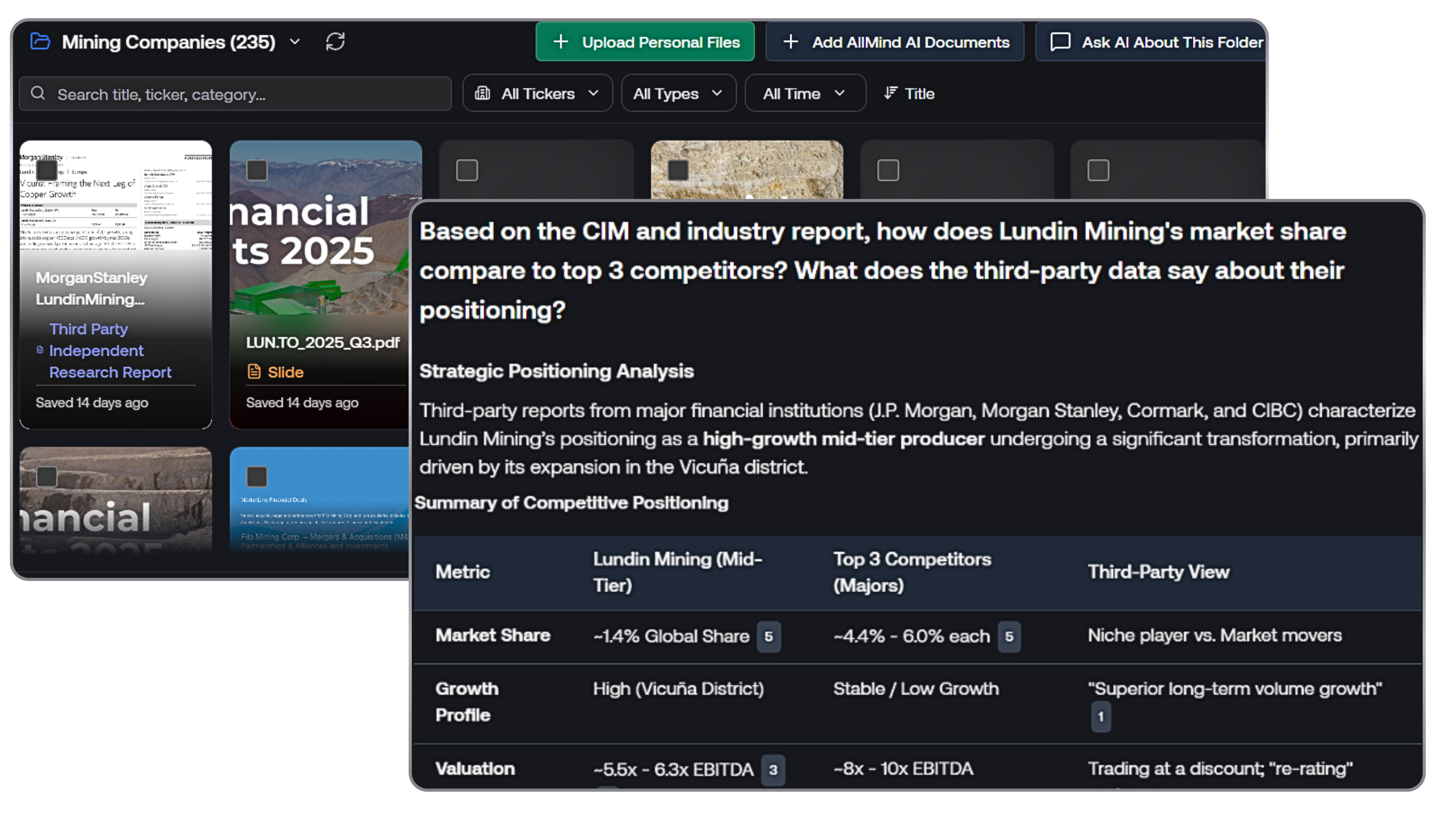
Skills answer a question, agents finish a job
Fiscal.ai’s unit of work is a prompt and a reply. It ships roughly two dozen prepackaged Skills, each teaching an MCP client one analyst task over its data. They are well scoped, useful and one-shot. Anything recurring is your own code listening to a webhook. On deliverables it offers modeling inside the terminal, a DCF row on every tier of its archived December 2025 pricing page.
AllMind’s unit of work is a project. An Agent Studio agent runs for minutes, hours or across days over many data points, and AllMind’s compare pages put a single automation’s reach at up to 200 companies, delivered as Word or PDF. The output matches: PowerPoint decks from 20+ investment-bank templates, Word memos, and Excel models for DCF, LBO and comps with live formulas, plus edits to existing PPTX, DOCX and XLSX files. A model inside someone else’s terminal is not a deck in your house format. AllMind’s own catch: deliverables land in a supplied template, so a bespoke format still costs a formatting pass.
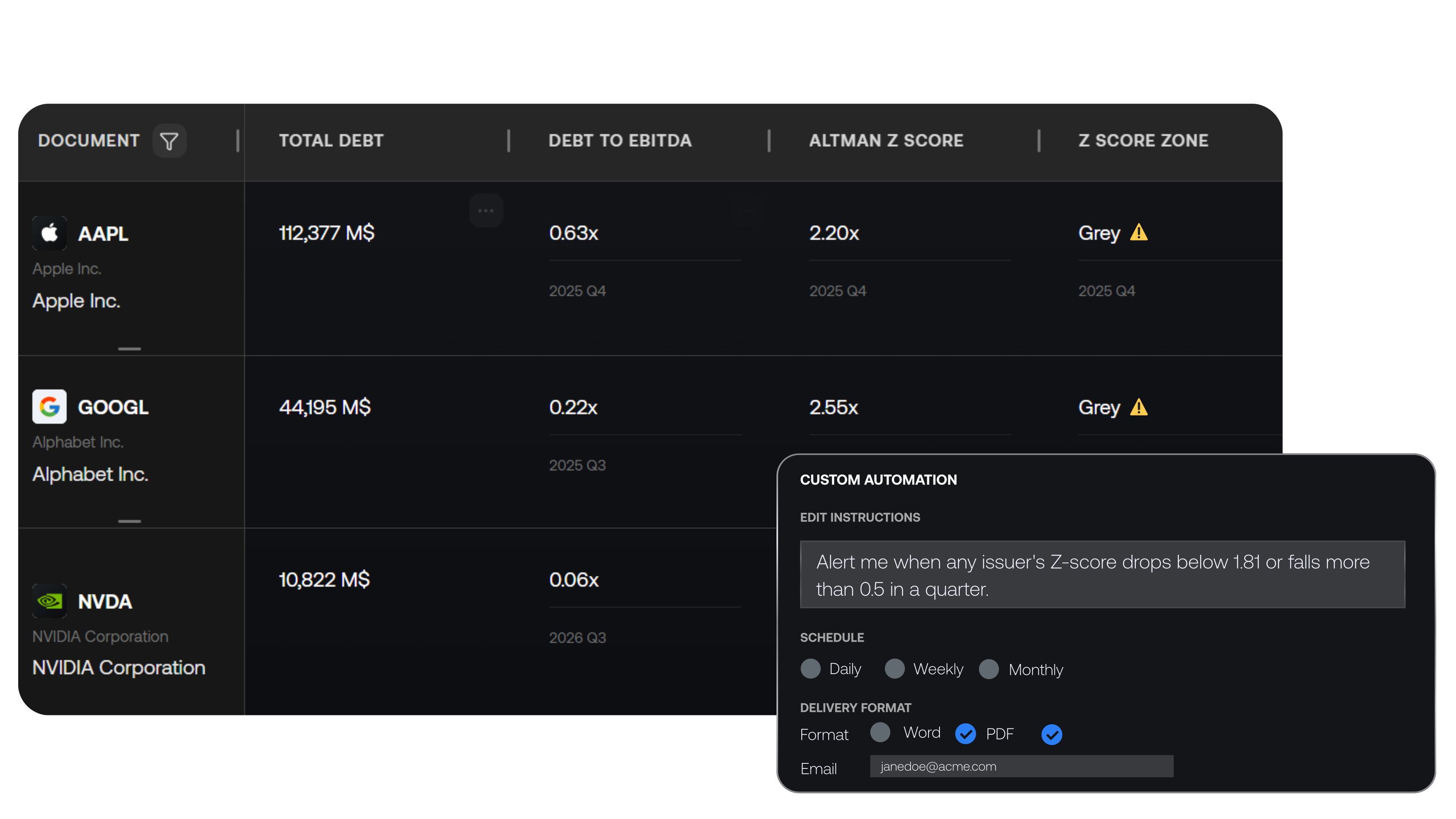
Where Fiscal.ai is strong
Fiscal.ai has done the unglamorous part of this business well. Its docs state 20+ years of annual and 40+ quarters of standardized financials, and endpoints that hand back the filing page image or PDF behind any figure. Segment and unit KPI data on the largest 2,300 companies is footnote work analysts usually do by hand, sold clean. The company said in April 2026 that it had more than 350,000 registered users and an API used by 70+ platforms and institutions, though that figure has been in market since June 2025.
It has also become plumbing inside other people’s products: a named connector in Claude’s connector directory, shown as made by Fiscal.ai, a partnership with Aiera announced March 2 2026, and ChatGPT Developer Mode and Codex CLI among the 20+ MCP clients its docs support, each one a connection you configure with your own key. It is honest about its scope, too. It sells data and a terminal over that data, and does not claim to be a governed research system.
A data product you plug in, or the workspace the research happens inside
AllMind
AI research system for institutional investors
AllMind runs a financial ontology under a set of AI agents: companies, suppliers, customers, estimates, filings and the firm’s own research held as entities and relationships rather than documents in an index.
It is bought for long, multi-source work that spans broker entitlements, expert calls, live earnings and a firm’s own warehouse tables. It sells by quote, to banks, hedge funds and large corporates, usually replacing several point subscriptions at once.
Fiscal.ai
Fundamentals terminal and financial-data API
Fiscal.ai launched as FinChat in 2023 and rebranded in June 2025 alongside a $10M Series A led by Portage, with Social Leverage and VanEck participating.
It sells a terminal over its own standardized public-company data, plus a documented REST API, webhooks and an MCP server on the same entitlements. The copilot answers from that structured data and links each figure to the filing it was parsed from.
What each one is good at, and what it costs you
AllMind
- 6,800+ premium data sources named by class, from broker research to Expert Insights and alternative data
- Internal warehouse tables queried in place, so no copy of your data leaves your environment
- Entities and relationships, so an agent walks supplier to customer to filing
- Agents that run for minutes, hours or days rather than answering one prompt
- Decks, Word memos and Excel models with live formulas, delivered as finished files
- SOC 2 Type II since November 2025, with every access logged
- No self-serve checkout and no monthly plan, so a non-institutional buyer is served better elsewhere
- Real depth means connecting internal systems, which is a data conversation rather than a signup
- Deliverables land in supplied templates, so a bespoke house format still needs a formatting pass
- Not a live trading or execution terminal, so the order still leaves through your OMS
Fiscal.ai
- A free tier and self-serve paid plans, reportedly tens of dollars a month
- A versioned REST API with an OpenAPI 3.1 spec, Swagger UI and disclosure webhooks
- An MCP server with 20+ named clients and a listing in Claude’s connector directory
- Roughly two dozen prepackaged Skills: comp-set, valuation, screener, capital-allocation, watchlist-monitor
- Segment and unit KPIs on the largest 2,300 companies, parsed out of filings
- Insider and 13F ownership, plus fund letters from roughly 780 firms since 2020
- No document upload, data room or warehouse connector in its public documentation
- No entitled sell-side research, expert-call transcripts or alternative data
- No published security attestation, so there is nothing to hand a compliance review
- Ownership covers US-listed names only, and intraday prices run 15 minutes late
What AllMind and Fiscal.ai actually cost
AllMind
Quote-based. No self-serve checkout, no monthly plan.
AllMind is sold through a sales conversation, as an enterprise or per-seat subscription. Anyone who wants to try something this afternoon is better served by a self-serve tool, and a retail or non-institutional buyer genuinely is. The argument it makes instead is consolidation: one system in place of several subscriptions, including content classes a desk is already paying for separately.
- Plans
- Enterprise and per-seat subscriptions
- Self-serve checkout
- None
- Monthly plan
- None
- List price
- Not published
Fiscal.ai
Self-serve tiers, on a pricing page that blocks fetchers.
Fiscal.ai sells subscription tiers from its own site, and the free tier means you can start without talking to anyone. That page returned HTTP 429 behind a bot check on August 30 2026, so current prices could not be read first-hand. The last readable copy is the same page archived December 15 2025, and the lineup has changed since: Enterprise is gone, a Max tier has appeared.
- Vendor page, archived Dec 15 2025
- Free, Pro $39 a month, Enterprise $199 a month, sales-led API
- Free tier
- $0
- Pro
- About $39 to $49 a month
- Max
- Above Pro, reportedly about $79 to $99 a month
- API and MCP
- Custom, sales-led; free trial key covers 100 companies and 250 calls a day
What changes the quote
The Fiscal.ai ladder buys depth, not seats: the product is sold to individuals. Its archived December 2025 matrix runs 10, 15 and 20+ years of annual history up the tiers, monthly copilot prompts at 10, 250 and unlimited, with exports and click-through to filing at the top tier and US stocks only.
On the API side the levers are entitled companies, calls a day and which packages are switched on, since the docs gate Skills on the matching data package: news, ownership, fund letters. AllMind’s number moves on seats, connected internal systems, the AllMind-licensed dataset classes and package rights enabled, and any buyer-specific access such as publication-time RMS entitlements.
Two of the three reviews carrying exact 2026 tier prices disclose a paid relationship with Fiscal.ai and hand out discount codes, and they are the only two giving the annual-versus-monthly split; the third gives a range and no Max price. In their favor, the archived vendor page shows they read the structure correctly, since the 20% annual discount and the top-tier gating of exports and filing audit are both on Fiscal.ai’s own page. The two contracts are not like-for-like in any case: one is a personal subscription bought with a card, the other a firm-wide agreement that arrives with connected internal systems, per-user entitlements and an audit trail.
Which one you want, task by task
Pull 15 years of segment revenue and unit KPIs for a large-cap semis name, source-linked, before a 2pm call.
Fiscal.ai’s Segments & KPIs package covers the largest 2,300 companies by market cap with 12+ years of history and links each figure to the filing page image. That is this job exactly, and nothing more than this job.
Build an initiating-coverage deck on a mid-cap using our broker notes, two expert calls and last quarter’s internal channel model in Snowflake.
Entitled broker research and Expert Insights transcripts sit in the same corpus as a Snowflake connection queried in place through a scoped IAM role, and the deck comes out of a supplied investment-bank template. Fiscal.ai holds none of those three inputs.
Pipe verified fundamentals into an internal dashboard, and give the PMs the same numbers inside Claude.
A published OpenAPI 3.1 spec with webhooks, plus an MCP server already listed in Claude’s connector directory as made by Fiscal.ai. AllMind documents no equivalent developer surface publicly.
Track guidance and KPI changes across 120 names every quarter, with an audit trail compliance will accept.
AllMind runs it as one scheduled multi-company automation under per-user entitlements that agents inherit, with every access logged and SOC 2 Type II behind it. A desk already licensing the Fiscal.ai API can keep it feeding the underlying fundamentals, since Fiscal.ai’s own automation story ends at a webhook into your code.
Show which analyst opened which broker note, and on what date, during a compliance review.
Entitlements are set per user and inherited by any agent that runs on their behalf, so an agent can never see more than the person who launched it, and every access is logged. Fiscal.ai documents plan-level API entitlements, not per-user permissions or an access log.
AllMind and Fiscal.ai reward different things: depth across entitled and internal data, or clean public fundamentals you can buy by the month or by the API key.
Choose AllMind when the question spans your broker entitlements, expert-call transcripts, live earnings and material in Snowflake, Databricks or S3, and the answer has to arrive as a cited memo, model or deck under per-user entitlements with an audit trail.
Choose Fiscal.ai when the job is standardized public numbers, quickly and programmably, and you would rather have an API key than a procurement cycle. Plenty of desks end up with both, because a Fiscal.ai tab and an institutional research system rarely compete for the same budget.
AllMind vs Fiscal.ai, answered
Only if the gap you are filling is public fundamentals. Fiscal.ai is a self-serve fundamentals terminal and data API with an AI copilot over its own structured data: financials, ratios, segment and unit KPIs on the largest 2,300 companies, filings, transcripts, US insider and 13F ownership, news and fund letters, each figure linked to its filing.
AllMind is a research system for institutional investors: entitled broker research, Expert Insights transcripts, live earnings, alternative data and your own Snowflake, Databricks or S3 tables, joined through an ontology under per-user entitlements with logged access. Fiscal.ai does not replace that, and does not claim to.
See AllMind on your own coverage
Join leading hedge funds and institutional investors who trust AllMind.Join leading hedge funds and institutional investors who trust AllMind to accelerate their research and analysis.