
AllMind vs PitchBook
AllMind carries private-company profiles and financials, PE and VC funding rounds, investors, and M&A records alongside its public-market, research, alternative-data, and firm-owned corpus. PitchBook is the deeper private-capital system of record, with fund benchmarks, predictive models, and a long historical record. The decision is how much private-reference depth the workflow needs, not whether AllMind has private-market data.
Agents work one question across private-company, funding and M&A records, companies, suppliers, estimates, filings, broker research, Expert Insights, market and alternative data, and your own systems, then return a cited model, memo or deck.
The case for it is the record. Morningstar’s FY2025 10-K describes PitchBook as tracking millions of private and public companies, investors, funds, deals, loans and executives, with more than 2,400 research reports published in 2025.
Choose PitchBook when the requirement is its deepest deal, fund, investor, benchmark, and predictive-model record. Choose AllMind when private-market records need to be researched alongside public, licensed, alternative, and internal data and turned into a deliverable.
Feature by feature
Private-market record
Private company profiles and financing histories
- AllMind
- Included; PitchBook deeper
- PitchBook
- Supported
VC, PE and M&A deal records
- AllMind
- Included; PitchBook deeper
- PitchBook
- Supported
Fund-performance benchmarks (IRR, TVPI, vintages)
- AllMind
- Not supported
- PitchBook
- Supported
Machine-learning valuation estimates
- AllMind
- Not supported
- PitchBook
- Supported
Exit-timing prediction model
- AllMind
- Not supported
- PitchBook
- Supported
Private-credit portfolio monitoring
- AllMind
- Not documented
- PitchBook
- Lumonic, acquired 2025
Public-market content
Broker and sell-side research in-platform
- AllMind
- AMR included; live via RMS
- PitchBook
- Not supported
Expert-call transcripts built in
- AllMind
- Expert Insights
- PitchBook
- Not supported
Live earnings and financials within minutes
- AllMind
- Supported
- PitchBook
- Unclear
The vendor’s own published equity research
- AllMind
- Not supported
- PitchBook
- ~1,600 companies
Your data and governance
Connects Snowflake, Databricks and S3
- AllMind
- Supported
- PitchBook
- Not supported
Indexes your own documents and data room
- AllMind
- Supported
- PitchBook
- Not supported
Per-user entitlements that agents inherit
- AllMind
- Supported
- PitchBook
- Unclear
Named security certification
- AllMind
- SOC 2 Type II
- PitchBook
- Unclear
AI and agents
Natural-language chat over the vendor’s data
- AllMind
- Supported
- PitchBook
- Navigator
Custom agent builder
- AllMind
- Agent Studio
- PitchBook
- Unclear
One run across hundreds of names
- AllMind
- Up to 200, AllMind states
- PitchBook
- Unclear
Vendor data inside ChatGPT, Claude or Gemini
- AllMind
- Not documented
- PitchBook
- ChatGPT and Claude; Gemini in preview
Deliverables
Builds Excel models with live formulas
- AllMind
- Supported
- PitchBook
- Not supported
Builds decks from investment-bank templates
- AllMind
- Supported
- PitchBook
- Plug-in only
Edits existing PPTX, DOCX and XLSX files
- AllMind
- Supported
- PitchBook
- Not supported
Excel and PowerPoint data plug-ins
- AllMind
- Not documented
- PitchBook
- Supported
Commercial
Published list pricing
- AllMind
- Not supported
- PitchBook
- Not supported
Primary pricing meter
- AllMind
- Quote-based
- PitchBook
- Licensed users
PitchBook marks come from Morningstar, Inc.’s FY2025 Form 10-K (filed February 2026), Morningstar’s Q2 2026 results release (July 28 2026), the PitchBook Navigator release (November 10 2025), Anthropic’s connector directory, and Morningstar’s Google Cloud announcement (August 25 2026), all read on August 30 2026. pitchbook.com returned a 403 to every fetcher tried that day, so “Unclear” means a capability we could not confirm in a source we could open, not one PitchBook lacks. That is also why no coverage count appears here: the figures in circulation trace to no PitchBook primary. AllMind marks come from its own product pages, August 2026.
See AllMind on your own coverage→What AllMind adds next to a private-market database
PitchBook closes the lookup, AllMind runs the work that follows it
A PitchBook query ends in a record: the round, the syndicate, the fund, the mark. Morningstar’s FY2025 10-K describes that record as tracking millions of private and public companies, investors, funds, deals, loans and executives. It is the reason the platform exists, and it is where the platform stops.
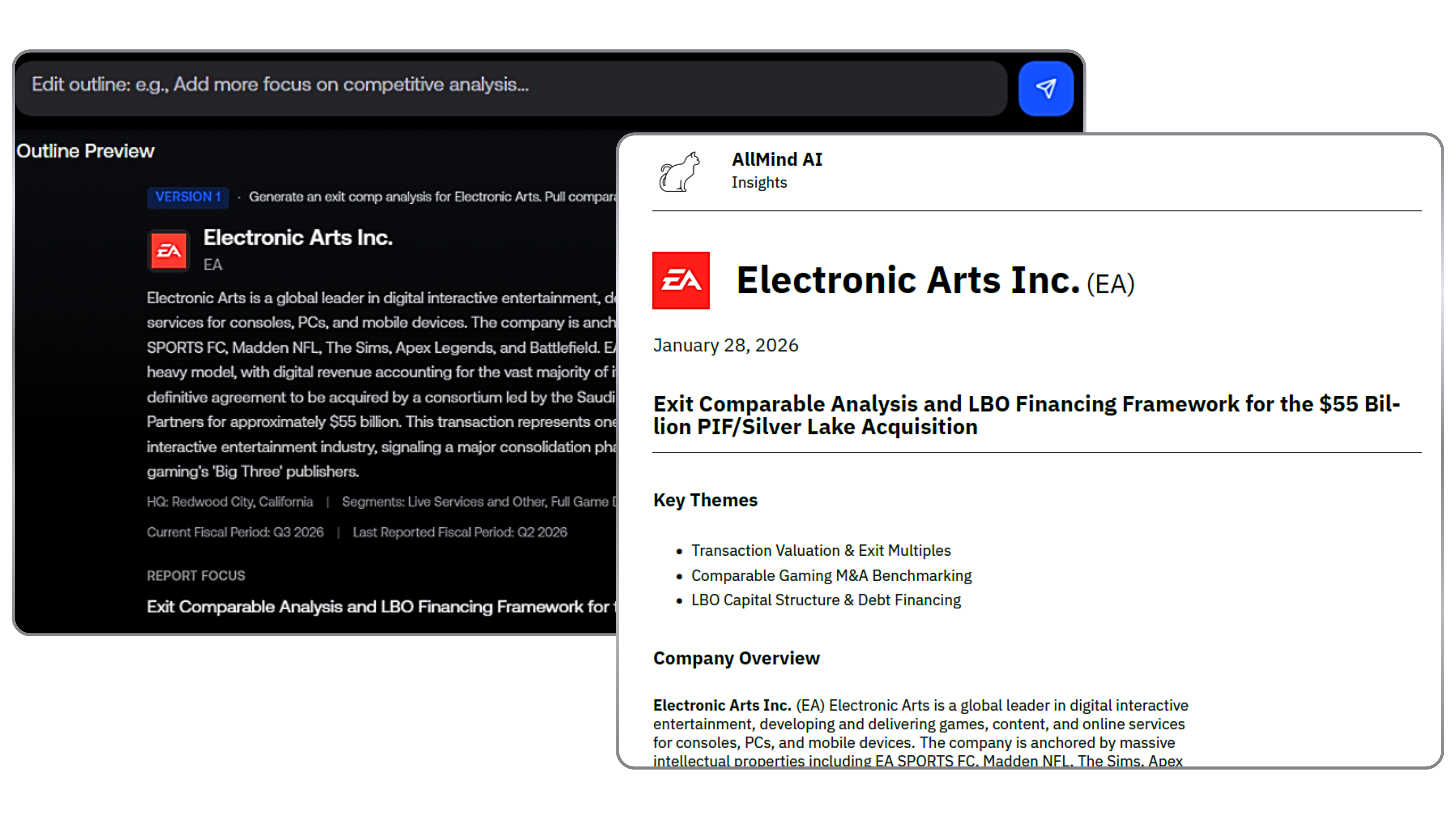
AllMind starts there. Its agents traverse an ontology tying a company to its suppliers, customers, estimates, filings and your own past research, so one question pulls the second-order names with it. Runs go long, minutes or hours, and AllMind states a single automation can reach as many as 200 companies. What lands at the end is the artifact: an Excel model with live DCF, LBO and comps formulas, a Word memo, a deck from one of 20+ investment-bank templates, or an edit to a file you already hold. PitchBook’s answer to that job is a plug-in that drops its data into a file you assemble yourself.
Most diligence questions start inside your own files
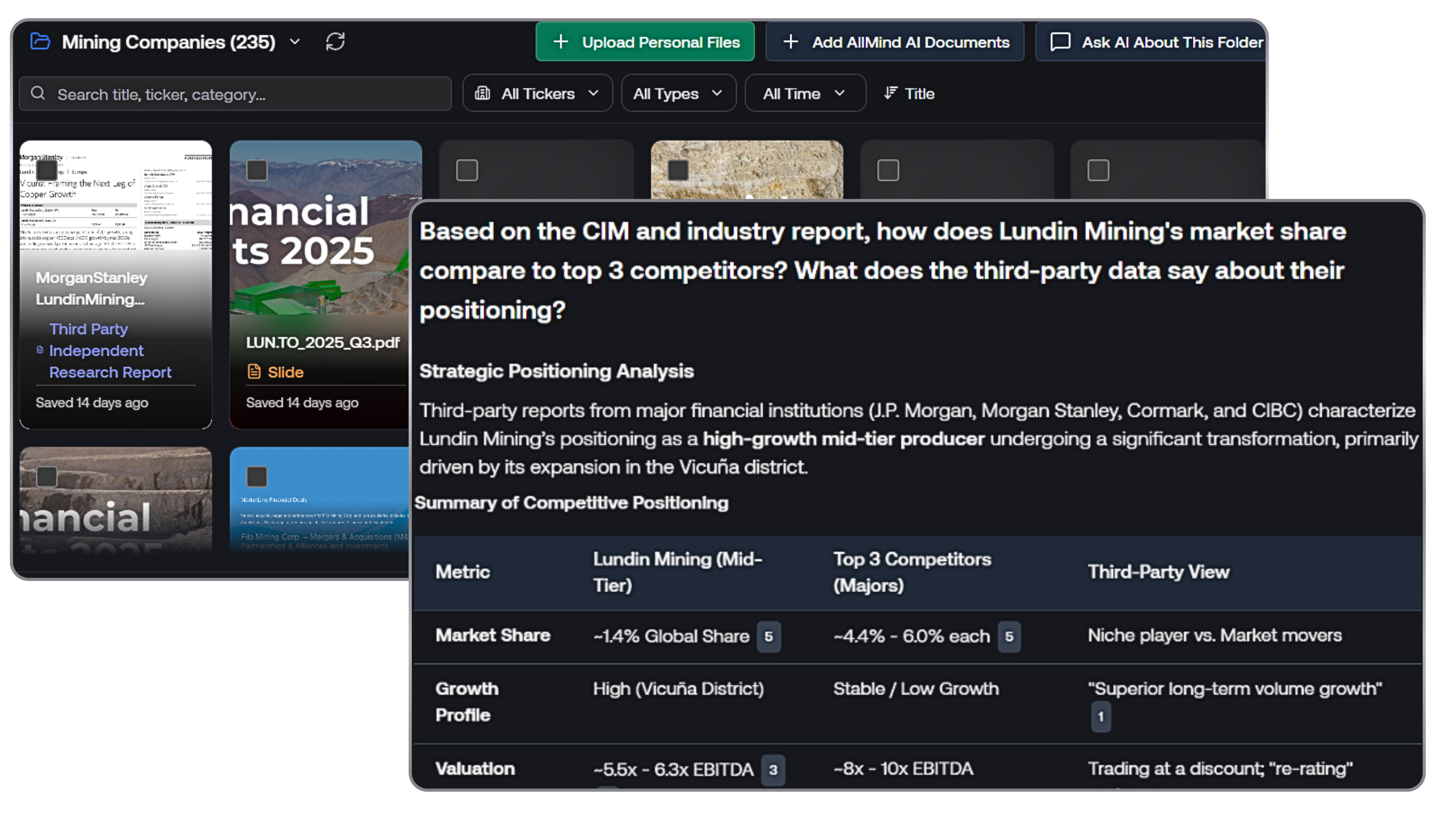
The awkward part of a diligence question is that the firm already holds half the answer, in a data room, a Snowflake table, or an IC memo from the last look that nobody can find. AllMind connects that side directly. Snowflake, Databricks and S3 attach through scoped IAM roles and are queried in place, so the tables never move, and Google Drive or OneDrive folders sync into a Data Room. Those sources join the external corpus inside one ontology, and the governance travels with them: agents inherit per-user entitlements and can never widen them, and every access is logged.
PitchBook moves the other way. Its 10-K describes distribution through mobile applications, CRM integrations, Excel and PowerPoint plug-ins and integrations with enterprise AI providers, and its connectors push PitchBook data out into ChatGPT and Claude. That is the right strategy for a data vendor. It is not a route for your own files to become part of the analysis.
Private-market depth does not cover a listed position
PitchBook’s public-market layer is real and narrow. The FY2025 10-K says its research center features Morningstar equity research covering approximately 1,600 companies, alongside the public company data that makes private comparison possible. A desk carrying listed positions needs a different set of content.
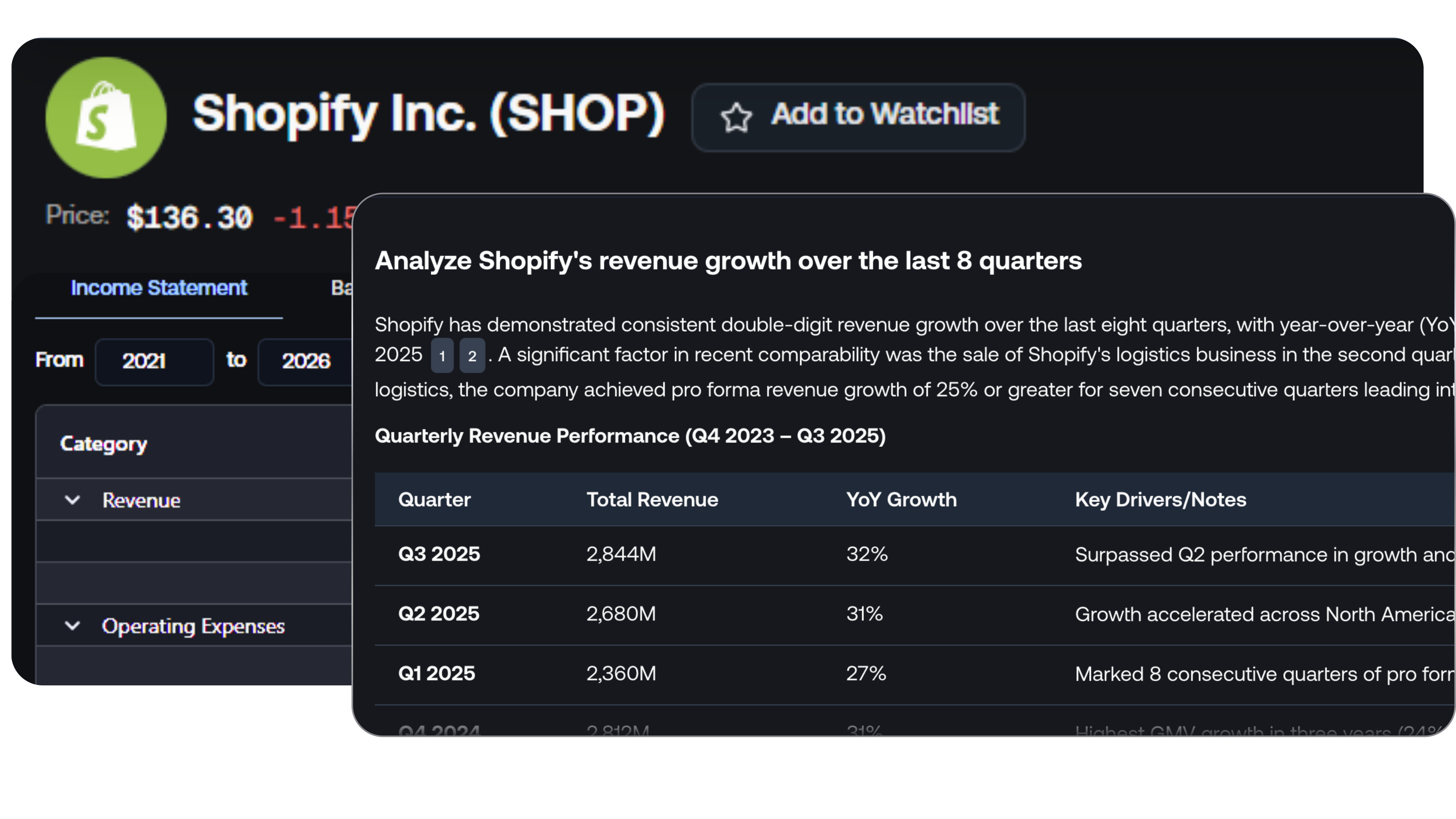
That set is what AllMind ships as built-in classes. Broker research sits in the platform, with the boundary that live embargoed research needs the firm’s own RMS entitlement while aftermarket research arrives on a delay that varies by broker. Expert Insights is one of those classes, so a desk reads expert-call transcripts without holding an expert-network contract. Live earnings and financials land within minutes, over S&P, FactSet, LSEG and MSCI data, consensus estimates, live news from thousands of sources, global investor-relations data and alternative data, across what AllMind states is 40+ exchange and venue feeds. One scope limit worth knowing: fund-level performance data, IRR, TVPI and vintage benchmarks, is not carried.
Where PitchBook is strong
PitchBook is the private-markets reference, and nothing above should read as if that were in doubt. Morningstar’s FY2025 Form 10-K discloses approximately 10,200 client accounts and 113,451 licensed users at December 31 2025, on $671.8 million of segment revenue growing 8.6%, with $210.1 million of adjusted operating income at a 31.3% margin. Q2 2026 added $174.7 million, up 4.9%. Be precise about the footing: the revenue sits in audited statements, the margin is non-GAAP, and the counts are operating metrics disclosed in Item 1.
Underneath it lies nearly two decades of deal, fund, investor and company records that no reasoning layer can reconstruct. On top of it sit quantitative products AllMind has no answer to: fund benchmarks, Manager Performance Scores, the VC Exit Predictor, and Valuation Estimates, which the filing calls a first-of-its-kind machine-learning solution covering thousands of companies. PitchBook has also been early rather than late on AI distribution. If your work starts with a private-market fact, start there.
One owns the private-capital record, the other owns the work over everything else
AllMind
AI research system for institutional investors
AllMind licenses 6,800+ premium data sources from 100+ providers and partners, including private-company profiles and financials, PE and VC rounds, investors, M&A records, filings, live earnings, broker research, Expert Insights, live news from thousands of sources, market data, alternative data, and the firm’s own systems. The ontology holds those inputs as entities and relationships, not isolated searches.
A run goes long across many data points, and every figure traces back to its source passage. What a seat can open depends on the package bought, the entitlements behind it, and the market-data permissions the firm holds.
PitchBook
Private-market data and research platform
Founded in 2007 and a Morningstar subsidiary since 2016, PitchBook is one of Morningstar’s five reportable segments; Exhibit 21.1 to the FY2025 10-K records Morningstar as owning 100% of PitchBook Data, Inc. The filing hedges its own claim: “what we believe is one of the most comprehensive collections of private market data and insights”.
Analyst research, fund benchmarks and predictive models sit on the record. The data reaches users through the platform, mobile apps, CRM integrations, Excel and PowerPoint plug-ins, and connectors into ChatGPT and Claude.
What each one is good at, and what it costs you
AllMind
- One ontology holds the public-market file and the firm’s own connected systems side by side
- Snowflake, Databricks and S3 read in place under a scoped IAM role, so the tables never move
- Broker research and Expert Insights transcripts ship as built-in content classes
- Excel models with live DCF, LBO and comps formulas, Word memos, and decks from 20+ investment-bank templates
- Agents inherit per-user entitlements, can never widen them, and every access is logged
- AllMind states a single automation can run across as many as 200 companies
- No claimed fund-level return, IRR, TVPI, or vintage benchmark dataset
- Deliverables land in a supplied template, so a bespoke house format still needs a formatting pass
- Live markets are North America and Europe today, with Asia, Africa and LATAM on the roadmap
- ISO 27001 is targeted for Q1 2027; SOC 2 Type II is the certification held today
PitchBook
- The private-capital record itself: companies, financings, deals, funds, investors and executives
- Fund benchmarks, Manager Performance Scores and investable indexes as shipped quantitative products
- More than 2,400 research reports published in 2025, across 30 analyst-covered sectors
- Approximately 10,200 client accounts and 113,451 licensed users, disclosed in Morningstar’s FY2025 10-K
- Profile, Investor and Transcript Summaries, the VC Exit Predictor and Valuation Estimates
- MCP connectors carry its data into ChatGPT and Claude, plus Excel and PowerPoint plug-ins
- No broker research or expert-call transcripts built in for a listed-equity desk
- Data is pushed outward through plug-ins and connectors, not joined to your warehouse or data room
- Revenue renewal rate slipped to ~103% in 2025 from 108%, with Q2 2026 licensed users flat
- Gemini Enterprise for Financial Services is in preview, not generally available
What AllMind and PitchBook actually cost
AllMind
Quote-based, nothing published
AllMind publishes no price. There is no self-serve checkout and no monthly plan, so every arrangement runs through a sales conversation, and a retail or otherwise non-institutional user is better served by a self-serve tool. No seat rate, tier list or meter is published either, so no dollar figure for AllMind appears below.
- All plans
- Quote-based
- Self-serve checkout or monthly plan
- Neither
- Published seat rate or meter
- Not published
PitchBook
No published list pricing
PitchBook has no public price page. Morningstar’s 10-K describes the commercial model instead: pricing “is primarily based on the number of licensed users, with customized pricing available for large enterprises, boutique firms, and startup clients”, while APIs and data feeds are priced by data volume, refresh requirements and technical specifications. The dollar figures below come from procurement data, not from PitchBook.
- List price
- Not published
- Pricing meter
- Number of licensed users
- APIs and data feeds
- Priced separately by volume
- Access inside ChatGPT, Claude or Gemini (preview)
- A separate entitlement
What changes the quote
PitchBook meters on named licensed users, so the bill tracks how many people log in rather than how much anyone reads. Module and entitlement choices sit on that seat count, and the 10-K says terms differ for large enterprises, boutique firms and startup clients without saying what those seats contain. APIs and data feeds are priced separately.
Reaching that data inside a third-party assistant is a further entitlement, open to eligible subscribers through software products with individual MCP integration access or through enterprise licensing. Procurement data names seats, modules and term as the drivers and puts no dollar figure on any of them. AllMind publishes nothing beyond quote-based.
Two cautions on that estimate. Vendr is the only PitchBook pricing dataset that survived scrutiny here, and it is not internally tidy: its body copy reads “Median buyer pays $31,875 per year ... Based on data from 132 purchases”, while the header block on the same page calls that number an average across 114 deals. This page takes the body wording, calls it a median and cites 132. A competitor-published band that circulates alongside it was left off, because the same publisher’s sister page states an incompatible per-user ladder. And a whole contract is not a seat, so the two sides of this section are not like for like.
Which one you want, task by task
Source and screen the sponsors active in industrial software, then pull the last three rounds and the syndicate behind each one.
AllMind carries private-company, funding-round, investor, and M&A data, but PitchBook’s deeper deal, sponsor, fund, and syndicate record is the better tool for this sourcing-first screen.
Benchmark our managers by vintage and defend the peer set in an investment committee.
PitchBook ships fund benchmarks and Manager Performance Scores as quantitative products, per the FY2025 10-K. AllMind publishes no fund-performance benchmark and should not pretend to.
We are diligencing a take-private and need the target’s private history, our own model and IC notes from the last look, the public comp set, and one memo out the other end.
Both platforms carry private-company and financing history, with PitchBook deeper on the historical deal, sponsor, fund and syndicate record. AllMind adds its own private-company, funding and M&A data to the firm’s warehouse and Data Room, joins all of it to the public file inside one ontology, and writes out the cited memo.
I cover 60 listed names and need a Monday note that reads every filing, transcript and broker piece from the weekend and lands in our template.
The deciding mechanism is AllMind’s automations plus template-based document generation, running over built-in broker research and live earnings. PitchBook has no equivalent production step, and its public equity layer covers approximately 1,600 companies rather than your coverage list.
AllMind and PitchBook are bought for different halves of the same deal: AllMind for the work that follows a name, or PitchBook for the record that produces one.
PitchBook leads when the purchase is for the deepest private-capital record, fund benchmarks, and predictive models.
AllMind combines private-company, funding and M&A data with public markets, broker and expert research, alternatives, and the firm’s own systems, then returns a cited memo, model, or deck. A team can consolidate more of the research stack onto AllMind while retaining PitchBook only where its reference or fund-performance depth is genuinely used.
AllMind vs PitchBook, answered
Yes for private-market research and diligence workflows, but not as a field-for-field replacement for PitchBook’s deepest fund and deal record. AllMind carries private-company profiles and financials, PE and VC rounds, investors, and M&A records across 6,800+ premium data sources licensed from 100+ providers and partners.
Keep PitchBook when the job depends on its proprietary reference depth, fund-performance benchmarks, Manager Performance Scores, or predictive valuation and exit products. Choose AllMind when those records need to be joined to public, research, alternative, and internal data and turned into a cited deliverable.
See AllMind on your own coverage
Join leading hedge funds and institutional investors who trust AllMind.Join leading hedge funds and institutional investors who trust AllMind to accelerate their research and analysis.