
AllMind vs GLG
AllMind is an AI research system for institutional investors: filings, broker research, live earnings, Expert Insights and the firm’s own warehouse in one ontology, ending in a memo, model or deck.
GLG is an expert network, founded 1998, that recruits and schedules named experts and sells the transcripts back.
GLG originates evidence; AllMind reasons over it.
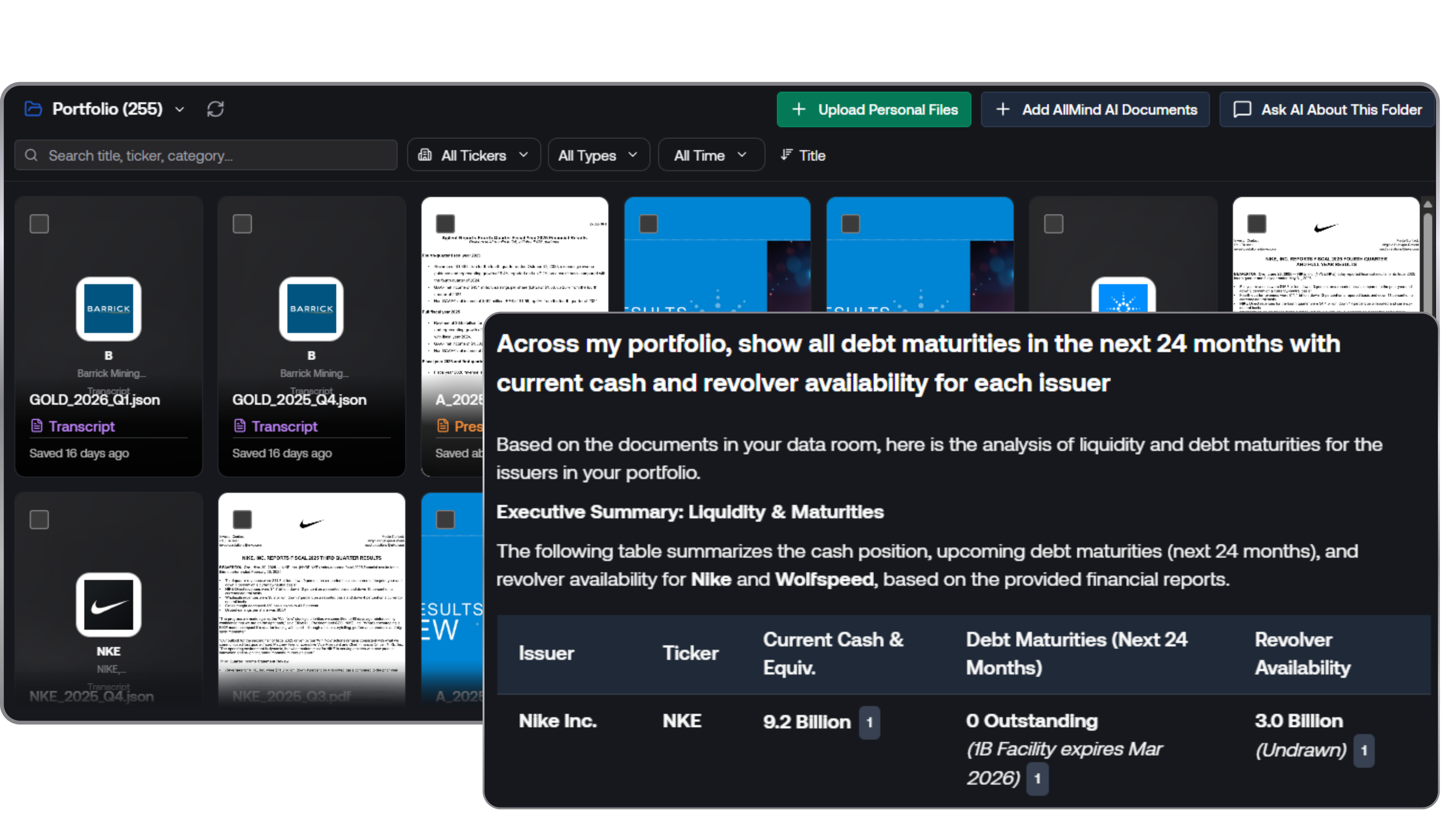
6,800+ premium data sources in one ontology, with the firm’s Snowflake, Databricks and S3 tables beside them. Agents stay on a question for minutes or hours and hand back a cited Word memo, Excel model or deck.
Custom recruiting against a network GLG states at over 1.2 million experts, 1:1 calls, AI-moderated interviews in ten languages, surveys and channel checks, and a library of transcripts attributed to named experts.
If the answer is still inside a practitioner’s head, book the call: no corpus contains it yet. If the evidence exists and the slow part is stitching it into a model and a memo, that is the AllMind case.
Feature by feature
Primary research
Arrange a new 1:1 call with a named expert
- AllMind
- Not supported
- GLG
- Supported
Custom-recruit an expert not already in a library
- AllMind
- Not supported
- GLG
- Supported
AI-moderated autonomous interviews
- AllMind
- Not supported
- GLG
- 10 languages
Quantitative surveys and sample sourcing
- AllMind
- Not supported
- GLG
- Supported
Channel checks across many experts at once
- AllMind
- Not supported
- GLG
- Supported
Expert content
Expert-call transcripts inside the subscription
- AllMind
- Supported
- GLG
- Supported
Transcripts attributed to named experts
- AllMind
- Not documented
- GLG
- Supported
Read transcripts without an expert-network contract
- AllMind
- Supported
- GLG
- Not supported
Published library size
- AllMind
- 100,000+ transcripts
- GLG
- 20,000+ (2023), ~500 added monthly
Where the transcripts are read
- AllMind
- Chat, tab, data room
- GLG
- myGLG, Bloomberg, FactSet, Claude
Market and company data
SEC and SEDAR filings
- AllMind
- Both covered
- GLG
- Not supported
Live earnings and financials
- AllMind
- Within minutes
- GLG
- Not supported
Sell-side broker research
- AllMind
- AMR included; live via RMS
- GLG
- Not supported
Alternative and supply-chain data
- AllMind
- Supported
- GLG
- Not supported
Analysis and output
Excel models with live formulas
- AllMind
- Supported
- GLG
- Not supported
PowerPoint decks and Word memos on demand
- AllMind
- Supported
- GLG
- Not supported
Multi-step agents across many sources
- AllMind
- Supported
- GLG
- Over GLG content
Automations run across a coverage list
- AllMind
- Up to 200 companies
- GLG
- Not supported
Internal data and reach
Snowflake, Databricks and S3 queried in place
- AllMind
- Supported
- GLG
- Not supported
Data room for the firm’s own files
- AllMind
- Supported
- GLG
- Uploads for synthesis
Vendor corpus pushed into your systems
- AllMind
- Not supported
- GLG
- The Feed
MCP connector into your own AI tools
- AllMind
- Not supported
- GLG
- Claude, live
Available inside Bloomberg and FactSet
- AllMind
- Not supported
- GLG
- Supported
Commercial and trust
Published list pricing
- AllMind
- Not supported
- GLG
- Not supported
SOC 2 Type II certified
- AllMind
- Since Nov 2025
- GLG
- Not documented
Compiled August 30 2026 from GLG’s product, compliance and security pages, its October 2021 S-1, and AllMind product documentation. “Not documented” means the company publishes nothing either way, a gap in disclosure rather than a missing feature: GLG’s security page describes quarterly internal and third-party reviews but names no certification, and AllMind does not state whether Expert Insights transcripts are attributed. The 20,000+ library figure comes from a GLG post of October 30 2023 and still appears on its expert-calls page, while GLG’s MCP page sizes the same library as “tens of thousands”. AllMind covers EDGAR, SEDAR+ and global filings, with live markets spanning North America and Europe.
See AllMind on your own coverage→Where an expert network stops and a research system starts
GLG makes evidence that does not exist yet. AllMind reasons over the evidence that does.
GLG originates evidence; AllMind reasons over evidence that already exists. GLG recruits a named expert, screens them under an annual sector-specific compliance tutorial, arranges the call and hands back an attributed transcript, and since August 6 2026 it can run that interview autonomously in ten languages with no calendar coordination. None of that output existed before somebody paid for it.
AllMind starts where evidence already exists. Its ontology carries companies, suppliers, customers, estimates, filings and the firm’s own research as entities with relationships between them, so an agent follows a supplier through to its customer and on to an estimate revision instead of pulling ten documents and hoping. Around it sit 6,800+ premium data sources: S&P, FactSet, LSEG and MSCI data, broker research, global investor-relations data, live news from thousands of sources, live earnings and financials within minutes, alternative data, and Expert Insights. Neither substitutes for the other. A desk that only reads transcripts is paying twice; a desk whose thesis turns on channel behavior needs a human on a phone.

A transcript is where GLG’s work ends and where AllMind’s begins
GLG’s own AI layer stops at understanding. Its May 5 2026 myGLG release added what it calls precision synthesis tooling: summaries and collated themes across calls, expert content and uploaded materials, each insight traceable to a timestamp or quote. Its July 22 2026 MCP connector queries a client’s own call history and the Library from inside Claude. That is a real reading layer, and reading is where it ends.
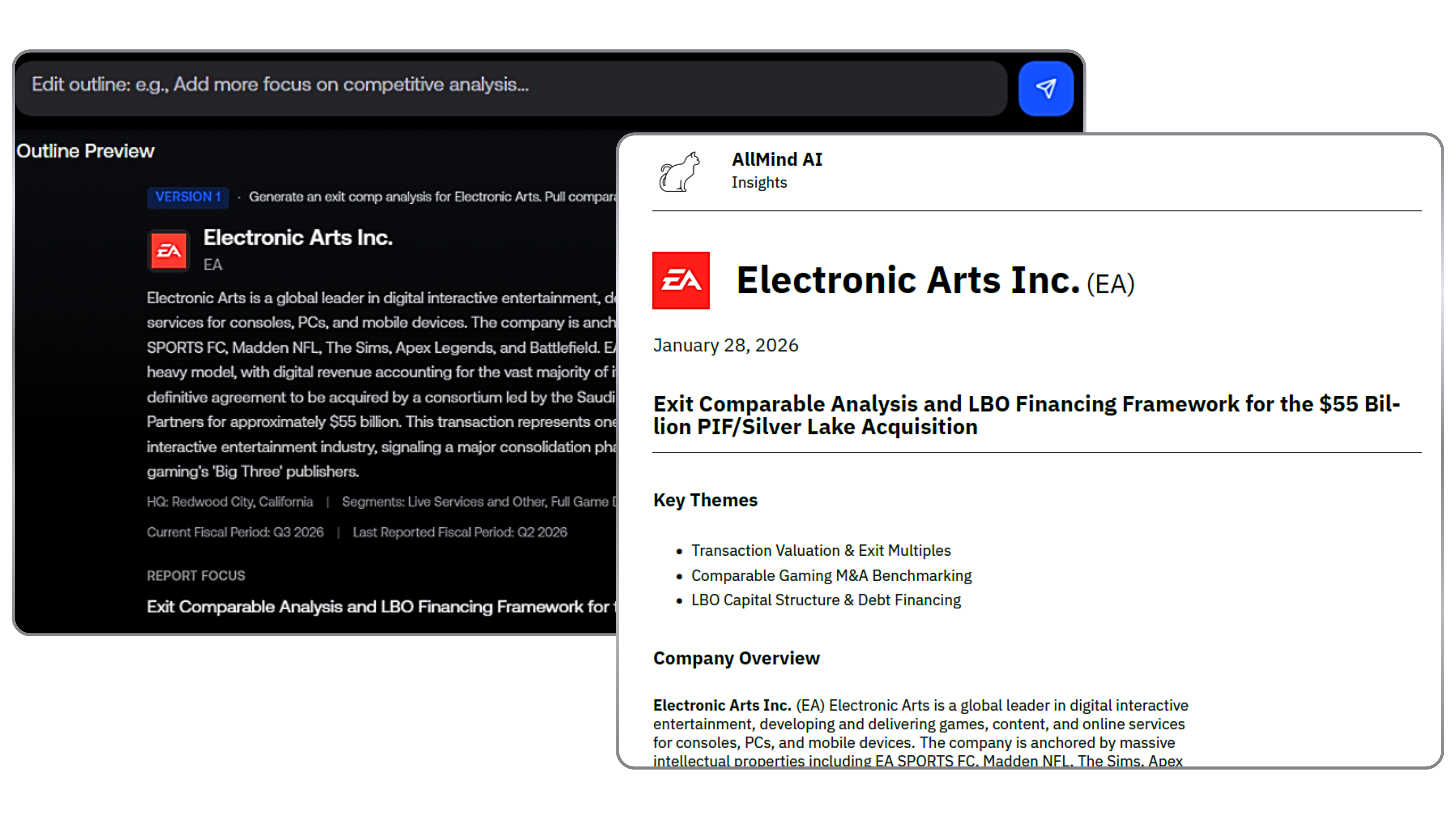
AllMind carries that transcript through to the artifact. One session reads the transcript, the filing and the broker note, queries the firm’s Snowflake, Databricks or S3 tables through a scoped IAM role, and returns a Word memo, an Excel model with live DCF, LBO and comps formulas, or a deck on one of 20+ investment-bank templates, every figure traced to the passage that produced it. GLG builds no models, decks or screens, and its asset-manager page does not claim to. The honest limit: deliverables land in supplied templates, so a bespoke house format still needs a formatting pass.
GLG polices what a person says. AllMind polices what an agent can see.
GLG’s compliance problem is a person; AllMind’s is an agent’s field of view. GLG guards against a live human saying something they should not, with a compliance team the company puts at more than 50 professionals, an annual sector-specific tutorial in 20 languages, millions of stored screening answers, a database of employer preferences it enforces, AI-assisted redaction, and configurable controls over transcript access, retention, download and AI summaries. GLG has been building that since 1998, and no research platform acquires it quickly.
AllMind’s exposure is an agent reaching data the person in front of it may not see. Its answer is per-user entitlements that agents inherit and can never widen, every access logged in and out, AES-256 at rest and TLS 1.3 in transit, no training on customer data, zero retention across model vendors, and SOC 2 Type II certification as of November 2025, with ISO 27001 targeted for Q1 2027. A firm running both needs both controls, because neither covers the other’s failure mode.
Where GLG is strong
GLG has done this since 1998, longer than any comparable network we checked. Its October 2021 S-1 disclosed roughly one million profiled network members, 2,700-plus clients and $628M of revenue for the twelve months to June 30 2021, and its surveys page states over 1.2 million experts today. Nobody audits those numbers, but a panel that size supports custom recruiting into a narrow niche, not just matching against a library, which is what a fund buys when it asks for a former regional distribution manager.
Its 2026 product cycle has been substantive: a rebuilt myGLG with a research agent and synthesis tooling on May 5, Expert Content inside Bloomberg’s ASKB beta on May 14, an MCP connector GLG says is live in Claude on July 22, and AI-moderated calls in ten languages on August 6. Integrity Research read that sequence, on May 25 2026, as GLG converting decades of proprietary expert interaction data into a retrieval advantage. On the evidence, that looks right. What GLG does, no retrieval system replaces.
Two companies solving different halves of the same question
AllMind
AI research system for institutional investors
AllMind holds external market data and a firm’s own systems in one ontology, a map of entities and relationships, and runs agents across it. The corpus is 6,800+ premium data sources: S&P, FactSet, LSEG and MSCI data, broker research, Expert Insights, live news from thousands of sources, global IR data, live earnings and financials within minutes, alternative data and sector-specific collections.
Agents work a question for minutes, hours or across days, and what comes back is a cited memo, model or deck. It is not a trading terminal and it does not recruit experts.
GLG
Expert network, founded 1998
GLG recruits, screens and schedules named subject-matter experts so an investor can ask a new question of a human being this week, then sells the transcripts back as a searchable library. Its own boilerplate calls it “the world’s leading platform for trusted human expertise”.
Alongside 1:1 calls it runs AI-moderated interviews, surveys, sample sourcing, channel checks, events and advisory placements, and it distributes its content into Bloomberg, FactSet and Claude. The page it publishes for asset managers names no filings, no financials, no estimates and no market data.
What each one is good at, and what it costs you
AllMind
- An ontology of companies, suppliers, customers, estimates and filings, mapped over 6,800+ premium data sources
- Expert Insights built in, so transcripts are read beside filings without a separate network contract
- Snowflake, Databricks and S3 queried where they sit, under a scoped IAM role
- Excel models with live DCF, LBO and comps formulas, Word memos, and 20+ investment-bank deck templates
- Automations run agents across a coverage list; AllMind states up to 200 companies in one run
- Per-user entitlements agents inherit and can never widen, and SOC 2 Type II since November 2025
- No expert-recruiting desk, no scheduling operation and no survey panel
- No self-serve checkout and no monthly plan, so evaluation begins with a quote
- No public page claims an MCP server, so nothing answers from inside Claude or ChatGPT
- Live embargoed broker research runs on the firm’s own RMS entitlement; aftermarket copy comes on a delay
GLG
- Custom recruiting against a network GLG states at over 1.2 million experts
- AI-moderated interviews run autonomously in ten languages with no calendar coordination
- Library transcripts described as unblinded and original, so the expert behind a quote is named
- Surveys, sample sourcing and channel checks, with a proposal in hours and results in about two weeks
- An MCP connector live in Claude, plus the Library inside Bloomberg and FactSet workflows
- A compliance team GLG puts at more than 50 professionals, with annual tutorials in 20 languages
- No filings, standardized financials, estimates, broker research or market data on its asset-manager page
- No models, decks, memos or screening; output stops at summaries and collated themes
- No published pricing; glg.com/pricing returns a 404 and every figure in circulation is a rival’s estimate
- Its security page names no SOC 2, ISO 27001 or equivalent certification
What AllMind and GLG actually cost
AllMind
Quote-based, and no rate card is published either
AllMind prices by quote. There is no self-serve checkout and no monthly plan, so a buyer who is not institutional is better served somewhere else. Nothing published states a seat structure or a tier list, so nothing here invents one.
- Published list price
- None
- How it is sold
- Quote-based, scoped with sales
- Self-serve or monthly plan
- Neither
GLG
No published pricing; every number below is a rival’s estimate
GLG publishes no rate card, no per-call price and no subscription tier, and glg.com/pricing returned a 404 when we checked it on August 30 2026. The figures below come from Inex One and Nextyn, both of which sell expert-network access, and from AlphaSense, which sells a competing transcript library. Read them as estimates published by interested parties.
- Published rate card
- None; glg.com/pricing returns a 404
- Average cost per expert hour
- $1,350
- Typical expert hour, any network
- $1,000 to $1,400
- Annual subscription, tier-1 networks
- $80,000 to $300,000+
- Per expert call, hourly
- $300 to $1,200
What changes the quote
None of this comes off a rate card. It is read off rival estimates and GLG’s own product pages. Three things move the bill and none is seats. First, how many new conversations a desk originates in a year, drawn against a prepaid credit balance where one call can consume more than one credit if the expert is senior, scarce or regulated. Second, which modules are switched on: calls, the Library, surveys and channel checks, events and advisory placements are scoped separately. Third, distribution, because The Feed and the Bloomberg, FactSet and MCP endpoints are a different contract shape. On AllMind’s side, the only published fact is quote-based pricing.
The two contracts are not like-for-like. One buys human hours and the compliance record around them; the other buys a system that reads what a firm already licenses and already owns. A desk running a heavy diligence calendar will pay GLG materially more than a desk doing occasional thesis checks, and no published source puts a multiple on that gap, so this page does not print one.
Which one you want, task by task
I have three days to test whether a hardware vendor’s new channel partner is actually shipping units.
This is origination. The answer sits in a distributor’s head, not in a filing, and GLG’s custom recruiting plus AI-moderated calls in ten languages can put several of those heads on record inside the window. AllMind’s Expert Insights helps only if somebody has already been interviewed on the question.
I cover 60 names and I need a one-page brief on each within a day of the print.
One automation runs agents over the ontology across the whole list and delivers Word or PDF; AllMind states up to 200 companies in a single automation. GLG holds no filings, no financials and no automation layer, and its page for asset managers names none of them.
Our investment committee wants a diligence file that names its sources and still holds up in a year.
GLG supplies unblinded transcripts attributed to named experts, under a compliance record built for exactly this, and AllMind makes no public claim about attribution for Expert Insights. AllMind supplies the rest of the file, with every figure tied to its source passage and every access logged.
We pay for expert calls we barely book, and we want fewer subscriptions.
If the desk reads transcripts but rarely originates a call, Expert Insights is already a built-in content class beside filings, broker research and live earnings under one set of entitlements. If the desk does book calls regularly, keep GLG, because nothing in AllMind replaces origination.
I want expert transcripts inside the AI assistant my team already uses.
GLG’s MCP connector is live in Claude on claude.ai and Claude Desktop with ChatGPT next on its roadmap, the Library sits inside Bloomberg and FactSet workflows, and The Feed pushes the whole corpus into a firm’s own environment. No AllMind public page claims an MCP server.
Two different bottlenecks, two different purchases: AllMind when the slow part starts after the evidence arrives, or GLG when the answer is still inside somebody’s head.
AllMind’s mechanism is the ontology and what runs on it: filings, broker research, live earnings, alternative data, Expert Insights and the firm’s own tables held as entities and relationships, with agents that stay on a question for hours and hand back a cited memo, model or deck.
GLG’s mechanism is a recruiting, screening and compliance operation that produces a named human on a call, now in ten languages, with a transcript attached. A desk that books calls regularly should read this as an add rather than a swap.
AllMind vs GLG, answered
Only for the reading half, not for originating new calls. GLG recruits and screens a named expert and puts them on a call, or since August 6 2026 runs that interview autonomously in ten languages; AllMind does neither and does not claim to.
What AllMind replaces is the transcript-reading subscription. Expert Insights is a shipped, built-in content class, so expert-call transcripts sit alongside filings, broker research, live earnings, IR data and alternative data under one set of entitlements. If your desk subscribes to GLG mainly to read the library, that is a genuine consolidation case. If you book calls regularly, treat AllMind as an add.
See AllMind on your own coverage
Join leading hedge funds and institutional investors who trust AllMind.Join leading hedge funds and institutional investors who trust AllMind to accelerate their research and analysis.