
AllMind vs Tegus
AllMind is an AI research system for institutional investors: filings, estimates, broker research, Expert Insights and the firm’s own systems in one ontology, ending in a cited memo, model or deck.
Tegus is an expert-call transcript library with a call-commissioning desk, sold inside AlphaSense since July 2024.
Tegus supplies the transcript; AllMind is where it gets used.
One ontology over filings, estimates, broker research, Expert Insights, live market data and the firm’s own Snowflake, Databricks or S3, with agents that work a question for hours and come back with the model or the memo.
An archive AlphaSense states at more than 300,000 transcripts across 29,000 to 32,000 companies, plus a desk that will commission a fresh 1:1 or an AI-led call at a published per-call fee.
If the gap is somebody who has actually run the business, Tegus fills it and AllMind publishes no way to commission a call. If the gap is the model and the memo, that is the AllMind side.
Feature by feature
Primary research
Commissions a new 1:1 expert call
- AllMind
- Not supported
- Tegus
- Supported
Autonomous AI-led expert interview
- AllMind
- Not supported
- Tegus
- Supported
Published per-call fee
- AllMind
- None published
- Tegus
- Expert rate + $75
Standardized call embargo periods
- AllMind
- Not supported
- Tegus
- 14 or 90 days
Channel checks as a standing program
- AllMind
- Not supported
- Tegus
- Supported
Expert content
Built-in expert transcript class
- AllMind
- Expert Insights
- Tegus
- Supported
Published transcript count
- AllMind
- None published
- Tegus
- 300,000+
Published company coverage count
- AllMind
- None published
- Tegus
- 29,000 to 32,000
Private-company expert coverage
- AllMind
- Not stated
- Tegus
- Supported
Analysis and deliverables
Chat over documents with passage citations
- AllMind
- Supported
- Tegus
- Via AlphaSense
Builds an Excel model on demand
- AllMind
- Supported
- Tegus
- Not supported
Pre-built drivable financial models
- AllMind
- Prebuilt Excel models, count unpublished
- Tegus
- 4,100+ Canalyst
Generates decks and Word memos
- AllMind
- Supported
- Tegus
- Via AlphaSense
Scheduled or event-triggered automations
- AllMind
- Supported
- Tegus
- Via AlphaSense
Data beyond expert content
Live market and exchange data
- AllMind
- 40+ exchange & venue feeds
- Tegus
- Not supported
Alternative and supply-chain data
- AllMind
- Supported
- Tegus
- Not supported
Entity and relationship ontology
- AllMind
- Supported
- Tegus
- Not supported
Consensus estimates
- AllMind
- Supported
- Tegus
- 8,000 cos via the AlphaSense add-in, 4,100 in Tegus Formulas
Firm data and governance
Queries your warehouse in place
- AllMind
- Snowflake, Databricks, S3
- Tegus
- Not documented
Indexes your own documents
- AllMind
- Supported
- Tegus
- Via AlphaSense
Entitlements agents inherit
- AllMind
- Supported
- Tegus
- Not documented
SOC 2 Type II
- AllMind
- Supported
- Tegus
- Via AlphaSense
Commercial
Sold as a standalone product
- AllMind
- Supported
- Tegus
- No public route
Published list pricing
- AllMind
- Not supported
- Tegus
- Calls only
Compiled August 30 2026 from tegus.com, the AlphaSense product pages and help center, and AllMind product documentation. Every Tegus figure is one the vendor publishes about itself. “Via AlphaSense” means the capability sits on the AlphaSense subscription a Tegus buyer signs, not inside Tegus. “Not documented” means the vendor publishes nothing on that capability, which is not the same as its being absent: on the warehouse row we looked for a Snowflake or Databricks connector on both sites and found none, and that is all we can honestly report.
See AllMind on your own coverage→What a research system does that an archive cannot
A transcript tells you who said it, not what it does to your numbers
AllMind connects expert content to everything else through a financial ontology, a maintained map of companies, their suppliers and customers, estimates, filings and the firm’s own research. Agents traverse those relationships rather than retrieving documents, so a question about a supplier’s pricing power moves from an expert transcript to the customer’s filings to consensus estimates to the desk’s own notes without an analyst carrying the thread by hand. Tegus is built around a single content class: search it and you get transcripts, ranked and filtered, with the reading and the reconciling left to you.
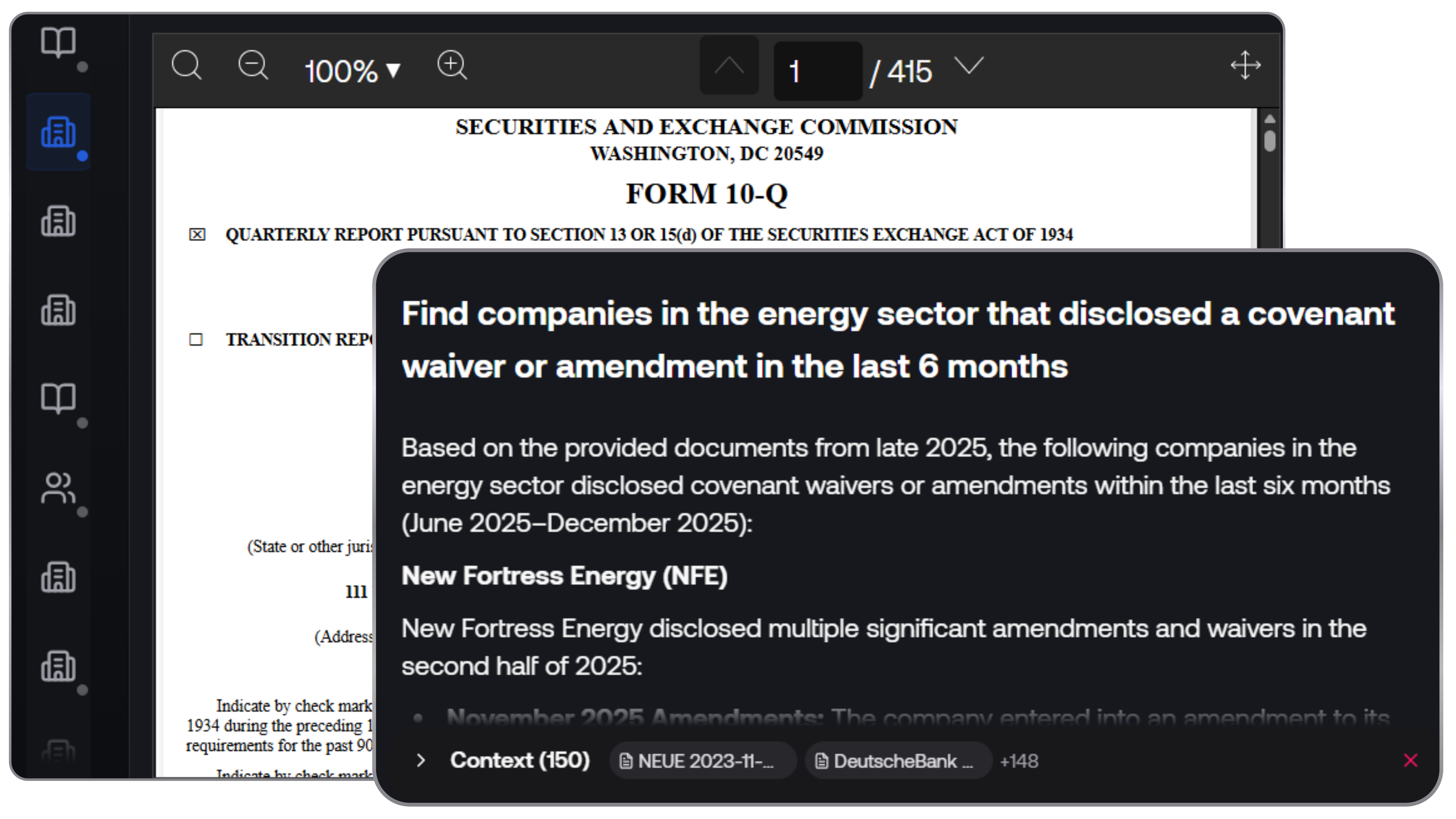
Expert Insights sits inside that map as a shipped, built-in class, opened from the Chat toggle, its own tab or a Data Room, which is how a team reads expert transcripts without signing separately for an expert network. The boundary is worth stating plainly. AllMind publishes 100,000+ expert-interview transcripts, and AlphaSense publishes more than 300,000 across 29,000 to 32,000 companies. If the count is what you are buying, Tegus wins that line.
The Tegus brand still has a website, but no buying route of its own
Buying Tegus in 2026 means signing an AlphaSense contract. On August 30 2026, tegus.com/pricing returned a 308 redirect to an AlphaSense pricing page that prints no prices, tegus.com/free-trial redirected to an AlphaSense trial request, and the AlphaSense pricing page filed expert calls under product add-ons. No page on either site says a standalone Tegus subscription was discontinued, and no public route to one is left.
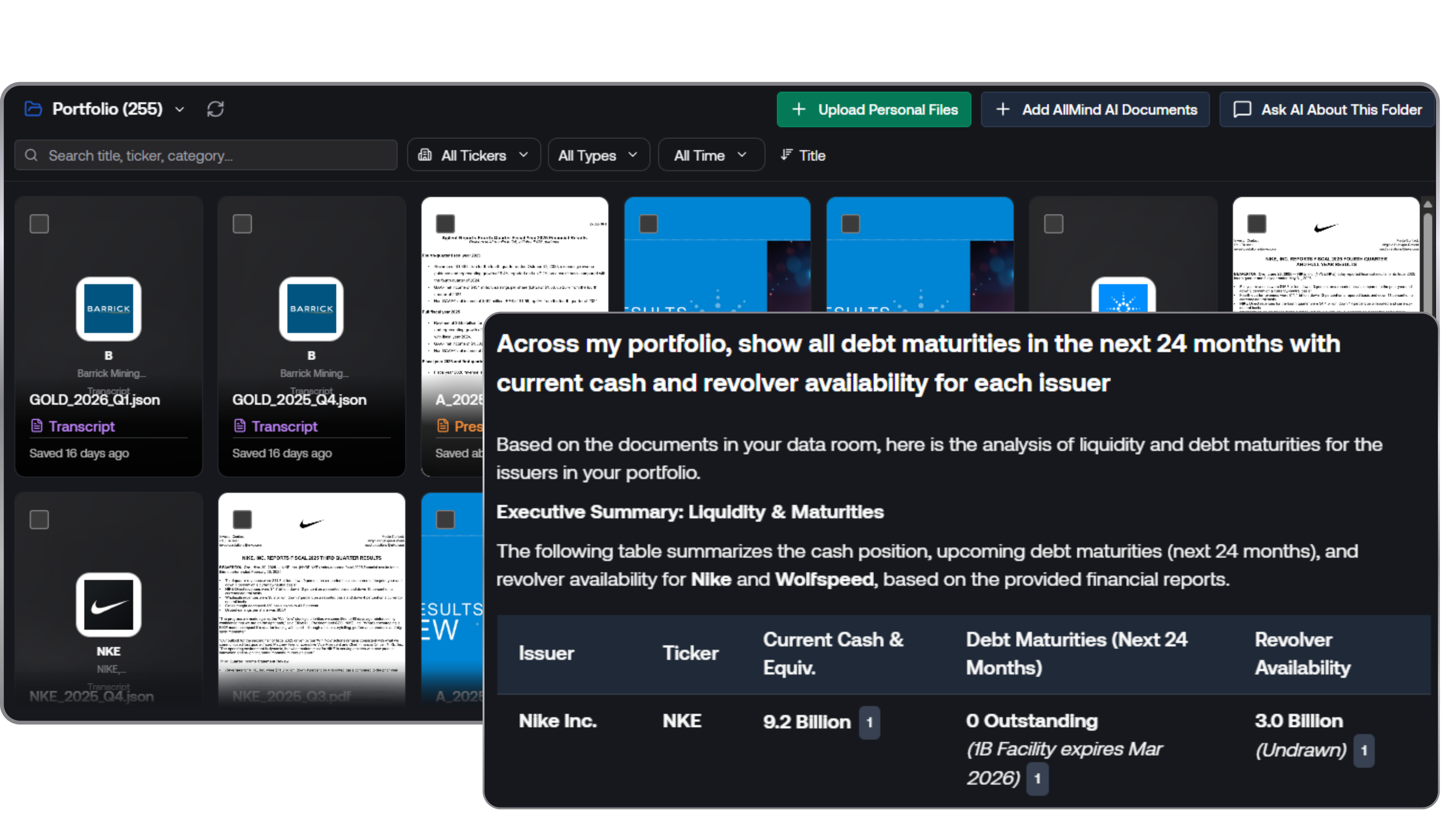
The absorption is still running: a help article updated July 15 2026 retires the Tegus Formulas Excel add-in on September 30 2026, and warns that formulas using consensus or pricing data may go stale from August 1 2026. So a 2026 renewal is an AlphaSense negotiation with content lines on it. AllMind is one quote-based subscription instead, and what it adds is not a second library: it reads Snowflake, Databricks and S3 in place through a scoped IAM role and joins them to the external corpus in the same ontology. The honest cost: this starts with a data conversation, not a signup.
The gap Tegus leaves is the hour after you finish reading
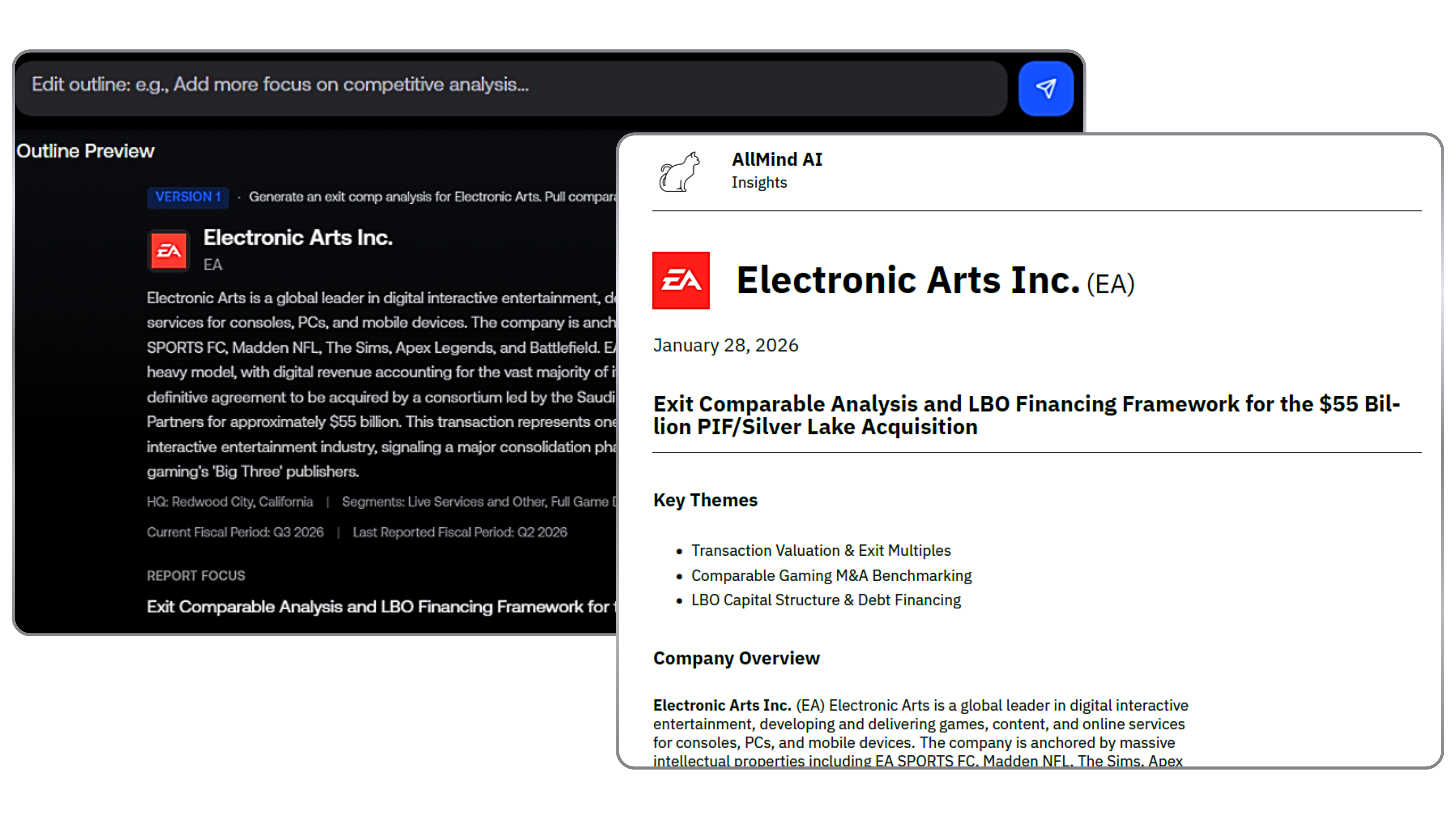
AllMind builds the deliverable in the same session. The deck comes back as PowerPoint against one of more than twenty investment-bank templates, the memo or research note as Word, and the model as Excel with live formulas behind the DCF, the LBO or the comps. Existing PPTX, DOCX and XLSX files can be edited in place. Every figure carries the passage it came from, the calculation stays visible, and a verification pass runs over the numbers before anything ships. AllMind also carries downloadable prebuilt company models in Excel, with operating KPIs and segment detail behind them.
Tegus supplies the inputs instead: the transcript library, plus roughly 4,100 pre-built Canalyst models carrying segment KPIs and operating metrics, a genuine head start on a name somebody else already maintains. Slide and memo generation on that side comes from AlphaSense’s Work Products add-ins and Workflow Agents rather than from Tegus. The limit on the AllMind side is that a deliverable lands in a supplied template, so a desk with its own house format still finishes with a formatting pass, and the judgment in the note stays the analyst’s.
Where Tegus is strong
No amount of software substitutes for the archive. AlphaSense states more than 300,000 transcripts across 29,000 to 32,000 companies depending on the page, with 8,000-plus added monthly, and said in August 2025 that it puts over $100M a year into the library together with its recruiting and compliance operation. Coverage reaches private companies that never file, which is exactly where a filings-first tool goes quiet, though AlphaSense does not publish the private share.
The commercial model is unusually legible too. A buyer pays the expert rate, which AlphaSense averages at about $450, plus a flat $75 transcription fee. On August 30 2026, Third Bridge, AlphaSights and Guidepoint published no pricing page at all, and GLG’s site blocked our check, though we did not audit those sites end to end. The compliance chain is documented as well: expert terms, insider-trading training, a pre-call questionnaire, AI-plus-human transcript review, and standardized embargoes. If your bottleneck is primary research in an opaque market, this is the asset AllMind has no equivalent for.
One is the primary research. The other is the system it gets used in.
AllMind
The AI research system for institutional investors
A research system that holds external content and the firm’s own systems as one map of companies, suppliers, customers, estimates and filings, then runs agents across it.
750M+ documents across 6,800+ premium data sources, and the classes matter more than the count: S&P, FactSet, LSEG and MSCI data; broker research; Expert Insights; live news from thousands of sources; global investor-relations data; live earnings and financials within minutes; alternative data; and, founder-stated, sector sets such as mining, healthcare and consumer staples. What leaves the system is a cited Word memo, an Excel model or a deck.
Tegus
The expert-call transcript archive, sold inside AlphaSense
An archive of expert-call transcripts, which AlphaSense brands as investor-led, with a desk that will commission a new call, sold today as content and service lines on an AlphaSense subscription.
AlphaSense completed the acquisition on July 8 2024 at $930M, per its own announcement, and tegus.com now leads with the line that Tegus is part of AlphaSense. The brand covers the Tegus Expert Transcript Library, Tegus Expert Call Services, the Canalyst models Tegus acquired in 2022, and BamSEC, which AlphaSense says Tegus acquired in 2021.
What each one is good at, and what it costs you
AllMind
- A maintained ontology of companies, suppliers, customers, estimates and filings that agents traverse instead of searching
- Expert Insights shipped as a built-in class, so no separate expert-network contract is needed
- Snowflake, Databricks and S3 queried in place under scoped IAM, plus Drive and OneDrive folder sync
- Excel models with live DCF, LBO and comps formulas, Word memos, decks from 20+ investment-bank templates
- Existing PPTX, DOCX and XLSX files edited in place, not only generated fresh
- Every figure traced to its source passage, with a verification pass before a report ships
- Not a live trading or execution terminal, so messaging and execution stay on a terminal seat
- No self-serve checkout and no monthly plan; every evaluation runs through sales
- SOC 2 Type II has been certified since November 2025; ISO 27001 is targeted for Q1 2027
Tegus
- AlphaSense states more than 300,000 expert transcripts, with 8,000-plus added monthly
- Commissions a 30, 45 or 60-minute 1:1 on a named expert, with no minimum commit
- An AI Interviewer runs the call, with a transcript typically inside 24 hours
- A published per-call fee: the expert’s rate plus a flat $75 transcription charge
- Roughly 4,100 pre-built Canalyst models, drivable in Excel with segment KPIs
- The wider AlphaSense corpus behind it, stated at 500M+ documents
- No standalone buying route: the pricing and free-trial pages both redirect into AlphaSense sales
- AlphaSense publishes two transcript counts, four company counts and three broker-network sizes
- The Tegus Formulas Excel add-in retires on September 30 2026
- No market data, no ontology, and no documented way to read the firm’s own warehouse
What AllMind and Tegus actually cost
AllMind
Quote only, nothing published
AllMind quotes rather than publishes: no self-serve checkout, no monthly plan, so a retail user is better served elsewhere. Three things set the figure: seats, how much of the firm’s own stack gets connected, and whether live embargoed broker research is in scope, since that needs the firm’s own RMS entitlement. Aftermarket research arrives on a delay that varies by broker.
- Expert Insights
- Included content class, no per-call rate published
Tegus
An AlphaSense quote, except for the calls
tegus.com/pricing has stopped being a Tegus page. On August 30 2026 it returned a 308 redirect to an AlphaSense pricing page that describes flexible subscriptions across team sizes and content needs and prints no figure. On the AlphaSense pricing page, expert calls appear under product add-ons rather than as a product, so calls are metered on top of whatever the subscription costs.
- Subscription
- No published price, redirects into AlphaSense sales
- Expert call
- The expert’s rate plus a flat $75 transcription fee
- Typical expert rate
- An average of about $450, published with no time unit
- Call commitment
- No minimum commit, or prepay a package that never expires
- Median contract
- $30,000 a year, low $13,000, high $65,200
- Historic per-user subscription
- Starting at $20,000 to $25,000, priced off fund AUM
- Historic per-call fee
- $550 a published call, on top of the starter fee
What changes the quote
Four things move the number, only one of them seats. Seat count and firm type come first. Then the content mix, since the transcript library, Canalyst models and broker research sit as separable entitlements. Then consumption of new calls, billed at the expert’s rate plus the flat $75 fee, prorated to the nearest 15 minutes. Then whether the firm brings its own broker-research entitlements.
Model the library as fixed cost and the calls as variable cost; the two behave nothing alike in earnings season. On the AllMind side the quote moves on seats, on internal systems in scope, and on the RMS entitlement live embargoed research needs.
The estimates are thinner than they look. Vendr does not say how many deals sit behind its median, and its own machine-written commentary on the same page quotes $25,000 to $150,000-plus, which does not reconcile with the $13,000 to $65,200 above it. The two historic figures, the per-user band and the $550 a call, trace to Tegus CFO statements from January 2021 relayed by two firms that sell expert-call access, so read them as one five-year-old data point, not two. The claim that prices rose after the acquisition also comes from a competitor. And an average expert rate is not a rate card: a scarce specialist costs more.
Which one you want, task by task
Test a channel-check thesis on a private device distributor before an earnings print, with nobody on the desk who has worked in that channel.
Tegus Expert Call Services decides it. The desk sources a named expert for a 45-minute 1:1, or runs the call with its AI Interviewer, and returns a transcript typically inside 24 hours after a four-step compliance review. AllMind publishes no route to commission a call.
Give a four-person credit desk one system that reads filings, broker research and expert transcripts, then writes the IC memo.
Document generation on top of the ontology decides it. Word memos and research notes come out with every figure traced to the passage behind it, over a corpus that already carries Expert Insights, so the desk gets transcripts without a separate expert-network contract.
Renew a Tegus contract that in practice was mostly Canalyst models and filings search.
On-demand model generation is the mechanism. Excel models with DCF, LBO and comps in live formulas, plus passage-level traceability into filings, cover what pre-built models and a filings search tool were bought for. Re-price rather than renew, and keep an expert-call line only if calls are consumed.
Diligence a founder-owned industrial roll-up with no public comparables and a CIM full of management’s own numbers.
This one splits cleanly. Tegus supplies primary research on a market that files nothing, and AllMind’s Data Rooms and warehouse connections put those transcripts next to the CIM, the internal model and the firm’s own history of similar deals in one place.
AllMind and Tegus sit on opposite sides of the same workflow: depth of work across everything a firm can connect, or the size and freshness of the expert archive.
Choose AllMind when the bottleneck is what happens after the reading: filings, broker research, expert transcripts and the firm’s own warehouse in one ontology, with a cited model, memo or deck at the end.
Choose Tegus when the archive is the asset, because 300,000-plus transcripts and a desk that runs a fresh call this week are not things AllMind replaces. For the transcript library this is usually an add decision, not a replace one; it flips to replace for firms that bought Tegus mainly for Canalyst models and filings search.
AllMind vs Tegus, answered
Tegus publishes no subscription price, only the cost of a single expert call: the expert’s rate, which AlphaSense averages at about $450, plus a flat $75 transcription fee, billed to the nearest 15 minutes.
On August 30 2026, tegus.com/pricing returned a 308 redirect to an AlphaSense pricing page that prints no prices. Whole-contract figures are estimates: Vendr shows a $30,000 median with a $13,000 to $65,200 range on a page stamped February 2026, and Inex One puts historic subscriptions at $20,000 to $25,000 per user per year, sourced to Tegus CFO statements from January 2021. AllMind is quote-based too, with no self-serve checkout and no monthly plan.
See AllMind on your own coverage
Join leading hedge funds and institutional investors who trust AllMind.Join leading hedge funds and institutional investors who trust AllMind to accelerate their research and analysis.